The God of small things

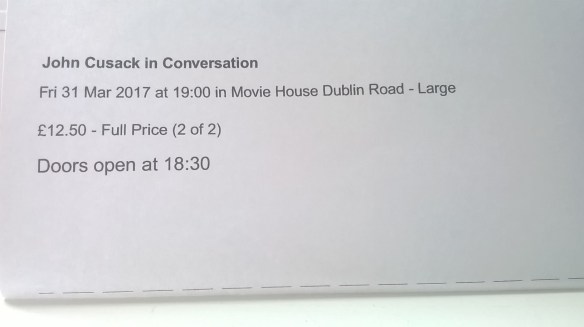
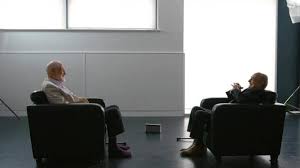
There’s a moment in the brief exchange between John Cusack and the front-row woman when he backtracks on something she says preventing the interviewer from moving on. Responding to her question on who he would like to see play him in a film, the interviewer deflects from a fairly non-commital answer to ask if she herself is an actor. An eruption of her own laughter ensues. “Ah no, sure I’m just a mummy”. Nervous audience titter. Moving on…

“But you’re not though, are you?”, Cusack cuts in. “You’re not just a Mom”.
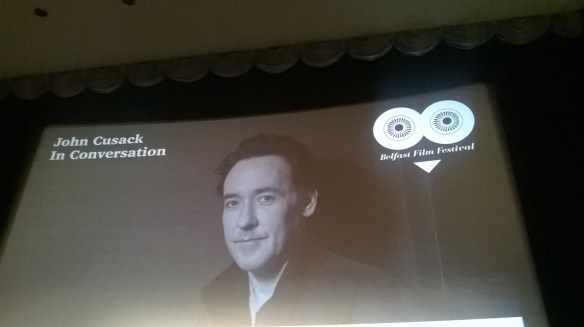
john cusack

(Not actual size)

She obligingly offers a quick run-through of the cliched litany of more superficial roles being a mother embodies.  Truth bending wizardry, poker-face maintenance, ‘parenting’ guru seeking missile manufacturing, baby-led led gagging reflex suffering, and so on. Nothing new in the rain-checking nor the predictable head-pat towards our ordinary heroes routine.

“Right. I think people spend too much time talking about what they’re not rather than what they are”, Cusack matter-of-factly tails off with a statement so banal on one hand, yet assembled in a way that’s not usually put. A sneaky shoulder-shrug prising open our pat take on things to see how they fall down. One that feels consistent with his knack for convincing off-kilter but on-the-nose pop philosophy of any of the outliers he has played.

And there it is. The moment I manage to steady the giddiness accelerating over days leading up to this evening from sliding into woozy dissonance from seeing him feet in front. Batting chat back and forth with an ordinariness shot through with an easy going passion for what matters. And what matters for many are the low-watt lights along our life’s arc that re-affirm the status of seemingly small things without blinding us with the certainty of big dreams.

In a world of heady obsession with status in the work place, our place along the firmament of social media, embarking on the Next Big Goal, the ephemeral nature of ‘success’, ordinariness is losing its necessary allure. In fact, I’m so ordinary,  all that’s missing in this navel led paragraph is a momentary pause to break through the fourth wall.

Oh there you are.

This John Cusack fella *points towards stage*, he thinks he is just an actor-activist guy. Nothing special. Sure, his is a life less ordinary; he knows it, we know it. He knows that we know that he knows it. But it hasn’t eroded his capacity to inhabit the regular guy with all the attendant dissections of his interior world and occasional flirtations with stretches to the perimeters of it. Relying as they do on the instruments of self-indulgence, wonky optimism, flawed curiosity, and mentoring from music.

*Turns back to the stage*

john cusack professional

Sinn Fein photobombs the professional photo (courtesty of twitter)
john cusack festival

My amatuer photo bombs spectacularly

He is not just the man I might’ve climbed over Dylan Moran to get to. Nor just an actor with enduring appeal. I recognise his characters now as those flickering gangway lights running along my own fanciful flights to cop-on and back over the years. Where lack of certainty is still direction, and being a fugitive from maturity is all part of the cycle. And it matters more what Bruce thinks than your line-manager.  Uplifted, I’m happy to break off from the queue lining up to meet him. To contentedly smile out the door and sing my way back to my frequently out-of-tune but thoroughly satisfying unsatisfactory life.

*credits roll*

(Press play)

“Some of your domains are expiring soon”

Even WordPress managed to get in on my birthday celebrations this week. Kudos to their payment department for reminding me my reign over critical spheres of influence is under threat.

Only this week, mealy-mouthed management shuffled into our office to trigger the act of bad articles in league with Brexit. The bogeyman made real. The pair of us will be lucky to be issued a three-month contract come the end of March. A monthly one thereafter if the mud sufficiently clears on the windscreen of uncertainty. If we get the wipers fixed. If anyone knows where to do that. If anyone knows if they still make them.

Difficult to know how to respond when you’re broke and casually demanded one of them to fire you the other week following a failed attempt at whistle-blowing. It was more of a protest yawn. Self-defeat by osmosis. It’s a thing. Probably. Difficult for them to know what to follow up the news with when their emotional peak consists of a burp after lunch. So they did that compassionate thing management do in a time in crisis and casually uncrossed their legs. And that was that.

Later that evening, I was forced to do the responsible thing and interrupt our wee one screaming protestations at her Da over a minor miscarriage of justice. Actually, sorry love, but that is in fact my role. After renewing our consistent parenting pact, he was forced to agree. Being usurped by a five-year old. The indiginity of it. What next – a robot with unpredictable mood swings and an irrational hatred of Stephen Fry?

Praise be for the kind buys of Merch. Birthday presents for the coping woman round town previously reliant on air-drumming at traffic lights.

handcream

*sniffs* Yep. That could work on creamcrackers 

johncusack

 Stalking Open at 06:30

sunglasses.jpg

Stalking glasses (see above)

Dress: Model’s own

coffee.jpg

Essential sturdy coffee coaster


Fabruary

“Found them. On my way” (Text to a friend while running to catch a train after losing my car keys)

“Hey” (Via muffled hug with same friend)

Two octogenarians taking in a piece of music dear to them both. The wave of emotion lapping behind their eyes, the crease of their lips threatening to blow it over the wall of their self-control (Meetings With Ivor)

“I can’t beat it” (Manchester By The Sea)

“He loved her that much, he almost told her” (Eddi Reader live – as good a raconteur as an octave-climing enthusiast)

“Please wait while your transaction is being processed” (An ATM)

” @itchybollix follows you” (Twitter)

“Red faces all round as there is a mix-up at the Oscars” (RTE News)

“I am currently out of the office with limited access to my emails” (Boss’s Auto-Reply)

“We are pleased to invite you to attend for interview…” (By post)

“She’s feeling better. They think it was just a virus. Worry over” (By text)

“Problem solved! Payment has been processed” (Email from Netflix)

“While you are away, my heart comes undone. Slowly unravels in a ball of yarn..” (Bjork at 1am as the ground is swept under my wheels)

“27th February” (Calendar)

“01:11” (Alarm clock)

“10:15” (ditto)

“Happy Birthday to you” (She to Him in top tonsil)

meetings-with-ivor

Two men and a CD player

Northern exposure

Part of the ritual of a trip to the flicks is a gawk at departing viewers as the lights come up and the credits roll.  It used to be an unconscious reflex, curiosity to see who else the film appealed to without processing it too finely. But this evening, the descent of young lads two by two-steps at a time is impossible to ignore. They are the Ceasefire Babies, arriving after the worst of it was over yet here they are, quietly absorbing a documentary on Hunger Striker, Bobby Sands. Like Sands needs any introduction.

The newly released documentary 66 Days is compelling viewing chronicling the turbulent period of Sands’s physical demise and corresponding rise of his political determination. It does so while unpicking the competing perspectives of those who considered him a freedom fighter with unflinching conviction against less generous assessments and categorisation of Sands and his comrades as terrorists. All the while transcending firm conclusions by illuminating the contradictions and hypocrisies of violence directed towards others alongside feats of self-sacrifice (something the IRA were not generally known for). Contractions that propel a handful of individuals into the universally recognised iconography of the oppressed. An enigmatic few with a rare ability to attract derision and admiration, often simultaneously.

For all its success at even-handedness, and impressive line-up of talking heads, it is a struggle to ignore the film’s lack of female voices. According to director, Brendan J Byrne, the women he ‘wanted’ (Sands’s sisters, Bernadette McAliskey) declined to participate. When pressed for a comment on Twitter, Byrne responded:

“..I know but it was mainly a war fought by men… Inserting a female voice for the sake of it felt tokenistic to me”

To this viewer, the inclusion of women would not have felt any more tokenistic than having Fintan O’Toole as the main analyst could be seen as a tactical effort to give the film broader respectability. Instead there is an entire male cast of historians, commentators, former politicians, and political analysts.

More critically, Byrne appears to ignore the finer aspects of his own film. For there are women everywhere throughout it, if silenced by the sound of men talking. So we do not hear the bin-lids we see them banging, nor their muffled cries of grief at funerals, nor the spoken-over stomp of their feet as they march in mandatory black berets and matching shades, nor their tearing down of corrugated iron surrounding the H-Blocks in an act that precipitated the eventual end of the Hunger Strikes seven months and 10 dead men after they started. Backroom strategists remain out of view.

As Bernadette McAliskey remarked only last week during a discussion on women in history: “history is what it says it is”.

An examination of war doesn’t require the insertion of female voices into the story for they are always to be found in the centre of it; feeling the impact of it more keenly than most.

sands_funeral24

Bobby Sands’s Mother & Sister at his funeral

5 reasons to see Sing Street

  1. For nailing the back-combed ’80s aesthetic. This is the film Spielberg might’ve made had he grown up in Ireland where the clergy were our alien life form
  2. For the nostalgia, particularly drowning out bickering parents with The Next Best Thing on the turntable, pausing momentarily to speculate on the fate of their marriage with similarly nonchalant siblings. But not for that long
  3. For a few seconds of The Blades’ Down Market
  4. For championing teenage misfits in all their hormonally simmering, earnest, clumsy world-conquering crusade. Especially Jack Reynor’s jaded 21 year-old teenager who has seen it all
  5. For making the clear case for why prom night always beats the most extravagant and wild debs. Always.

Remembering… Mary Raftery

“The Church thinks in centuries, do you think your paper has the resources to take that on?”

Stanley Tucci’s pithy lawyer puts it up to Mark Ruffalo’s investigative reporter early on in Spotlight, the deft dramatisation of The Boston Globe’s incendiary exposure of the systemic cover-up of widespread child abuse by the clerical elite. For decades. Sound familiar?

Hollywood thinks in blockbusters, but did it have the resources to take it on? Whatever about the availability of budgets, its success is due in no small part to an experienced cast willing to resist any scenery-chewing righteousness. The ever reliable Ruffalo captures the tenacity and flightiness of a truth vigilante on the verge of something big; but it takes Michael Keaton’s restrained editor to reign him in, having at one time been too eager to get over the finish-line himself. There’s big. But there’s bigger.

“If it takes a village to raise a child, it takes a village to abuse one”

Sound familiar? The axis of blind eyes and indifference kept on turning. Tucci can be trusted to deliver another unequivocal truth.

The audience of the Dublin cinema I’m in knows where the conclusion is headed. As does the rest of the Western world familiar with the story of Vatican corruption. Despite the multitude of spoiler alerts revealed over recent years, a reminder can still leave them sitting silent until the last of the credits roll. After the written updates on what happened next disappear; and the flashing lists of destinations revealed as locations where clerical child abuse investigations have taken place.

Ferns, Ireland. Gortahork, Ireland. And the rest. Counties are an irrelevancy.

RTÉ deals in small investigative departments, but did it have the resources to take it on? It had Mary Raftery.

“Mary was best known for her 1999 ground-breaking “States of Fear” documentaries. They revealed the extent of abuse suffered by children in Irish industrial schools and institutions managed by religious orders. It led to taoiseach Bertie Ahern apologising on behalf of the state.

Her work also led to the setting up of the Ryan Commission, which reported in May 2009, and to the setting up of a confidential committee which heard the stories of victims of institutional abuse.

Speaking about her findings to the BBC in 2009, Mary Raftery said: “There was widespread sexual abuse, particularly in the boys’ institutions.

“Extremely vicious and sadistic physical abuse, way off the scale, and horrific emotional abuse, designed to break the children.

“We had people talk to us about hearing screams… the screams of children in the night coming from these buildings and really not knowing what to do.

“They didn’t know to whom they could complain because the power in the town was the religious order running the institution.”

Following the documentaries, the government set up the Residential Institutions Redress Board which has compensated about 14,000 people”  Source: The BBC

mary raftery

Mary Raftery

Spotlight is a reminder of the power of Mary Raftery’s investigative journalism, and her fearless tenacity that served the village truth in the face of wilful blindness. In an era in which RTÉ doesn’t appear to be over-endowed with such resources, her contribution, and premature death, still has the power to pin the viewer to the seat for just a few seconds more.

Souvenir

“Who’d have thought it back then, eh”, she cackled before chomping down on her next pizza slice leaving my eyes raised longer than they’re used to. “You and I here having lunch with our kids.” An observation that didn’t merit such an intensive brow workout but I knew what she meant. “Aye”, I smiled over at her 12 year-old willingly enduring some type of Chinese burn from my one half his size.

Back then I was seventeen going on fifteen, she was nineteen going on thirty-four. She was all Anaïs Nin and Betty Blue, I was wondering if I’d ever catch up. Reading between the mouthfuls, we’re simultaneously impressed and appalled that we’ve made it this far without social services intervening. Neither of us point out we’re the same meaning-seeking junkies who re-cycle soul searching question marks into ninth degree levels of scrutiny. Not that we haven’t modified our behaviour. The smoking ban saw her banish herself from her own living room to the porch, and I no longer pretend to be excited when she offers to read my tarot cards. The game is more or less up. But we never run out of if-onlys that temporarily tear down our doubts. If only for the time we’re together.

Later I’m half listening to my niece breathlessly instructing me on the city’s cultural scene. I’m distracted by her contemporary Nana Mouskouri range glasses and theatre-curtain velvet hair. She’s talking to me with an intensity she is perfectly at ease with so I plant us both in an imaginary indie film we’re starring in without her consent. She’s all cinemas with cool cafés that show It’s A Wonderful Life at Christmas. I’m all up for it this year, and for almost telling her I remember the cinema in its original incarnation a few streets over in the city centre. And how I thought the break during An Angel At My Table was actually the end. But that would cast me as an elder city alumnus desperately going on nineteen. If only.

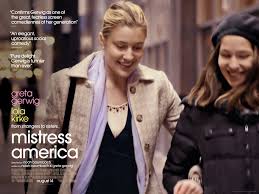
I can still turn a few knees though so I mumble apologies and sink into the middle seat for the evening to watch the real darlings of indie film. Greta Gerwig is breathlessly tearing down all doubts her thirty year-old character has about her latest business enterprise . But it’s the towering self-belief she radiates that boomerangs to tear the ground from under it completely. That, and her knack for the lack of follow-through.

Just as the Curly Wurly has imperceptibly shrunk over the years, the cinematic mid-life crisis appears to have slid back down a decade. At thirty, my Olympic levels of procrastination had yet to peak, and the ideas weren’t within reach. So I invest my nostalgia in the younger character. One who’s dining out on wobbly self-assurance, as yet unacquainted with the pallbearing potential of fear and laziness. She’s all fresh-faced and woollen-jumpered eagerness; I’m all leg-cramp and delicately trying to open the Maltesers without a sound.

They descend into screwball farce, and I fall for it and headlong into a reverie that shares little with them. Except  the nerve tugging soundtrack, their stamina for late-night drinking, and the naïve belief it’ll all come together eventually.

The credits role but I’m left stranded in a frame of my life from long before the one I’m in was written. People travel miles to escape the monotony and humdrum of their daily lives; I flee mine completely for a mere seven quid  an hour down the road.

Post-film daze, I stare ahead in the mirror as I wash my hands in the bathroom. Forever make-up free having procrastinated over synthetic attempts at freshness, however necessary now. My feet risk an autopilot return to an old student flat.

I ring the doorbell and await the shuffle of feet, the fumble of keys. The door opens and I wonder how I got here, and who these two people are, if only for a few seconds while I adjust my mind-set and make it back to now. Somewhat reluctantly.

mistress america

Malteser opening not featured in OST

To the basement, people!

Many surprises await you. Not really. We don’t have a basement. But as a carrier of chronic basement envy, I understand your disappointment.

It all happens in the basement.

Annie Wilkes almost killed off her beloved author in one in Misery. Yes, that was indeed the sheriff who met his untimely demise down there. Nasty. So it made a tense tale even more nail-biting.

Then there was Omar who took refuge in his sister’s basement when it mattered most. So it contributed to the necessary rehabilitation of one of TV’s most beloved characters before… well, before… actually, let’s not talk about it. It’s still too soon. And who could forget Elliot discovering E.T. behind the garbage cans in his. OK, me neither. So they also compel people to re-write scenes from perfect Steven Spielberg films. Still. No doubt the great director regrets missing that trick.

Occasionally, a basement will turn up in a song, and fans of this gem will recognise the reference. My new favourite thing is to drive around town with it blaring on repeat and master my air-drumming as we crawl through traffic. I discovered this retrospectively when I found myself lip-syncing the same chorus to the tenth person over the course of one journey.

Fans of Two-Door Cinema Club are probably aware that the group has a combined age of 8 and three-quarters. I’m certain they’re of an age that I could’ve given birth to all three, a fact I discovered when we showed up at one of their early gigs to be offered the only available seats next to their parents. One for the grandchildren. Oh no, wait, they were on the dance floor.

But few may know the origins of their name, which stems from a venue featured in the new segment of the blog. Welcome to Lesser Spotted Ulcer! Finally, the point of the post! Where every now and again, when I take the notion to remember, we visit one of Norn Iron’s hidden gems. No, really. tudor private cinema in comber county down northern ireland the tudor was built by brothers noel and roy spence in the garden of his house on what used to be a chicken shed First up, Tudor Cinema in Comber. A cute mispronunciation by a local boy inspired the moniker of his brilliant band. It’s privately owned by the lively Noel Spence, owner of 1000s of titles, which he will cheerfully allow you to scan through to book film and screen for a modest donation (no fees as such, or children allowed). Including E.T. and Misery. Donnie Darko, also. And The Blair Witch Project. Or any other film with a critical basement scene. He’ll even put up a personalised welcome message with the classic letters above the entrance. And if you’re lucky, he might give you a free copy of some native yarns and poetry in between performing his roving ice-lolly dolly duties. It takes a decent local map and frequent passenger-window-winding-down for directions to refine this map further, but it’s worth the recline into a red velvet seat when you do.

To Noel, my inaugural rosette. Go Noel (canned applause).

tudor interior

Tudor Cinema. (audience not pictured)

And that concludes this week’s edition. Tune in next time when we’ll be visiting the Stiff Little Fish Fingers factory.

Five reasons to see Song of the Sea

song of the sea

1. For its paced and magical weaving of Irish legends into an enchanting tale of wonder

2. For its stunningly beautiful animated odyssey that goes where CGI and Pixar could never venture

3. For reminding us of the power of our own fables in addressing the big issues of life in unexpectedly moving ways we had possibly forgotten

4. For enthrallingly transporting a child to a place where its eyes are transfixed on the screen like rarely before

5. For letting an old cynic be that child