Suggestions for teachers unsure what to do with children opting out of sacramental preparation

  1. Have them listen to an entire Mumford & Sons album and ask them to re-assess their view on the possible existence of The Devil
  2. Original sins: Get them to think up and agree a new one, thereby developing their capacity for moral reasoning and consensus
  3. Role play: The Silent Majority. Get them to just sit still and say absolutely nothing (Confirmation class age only)
  4. Host a Q & A session with Jim Corr. Facilitate them to decide which one of them will be Jim Corr (Communion class age only)
  5. Play Spot the Difference:

enyachris de burgh

Chris de Burgh                        Enya

The green of Ireland

In a taxi from the cinema to a hotel in the middlin’ to fair South East..

“So where you from?”

“Donegal”

“You went a long way to go to the cinema”

“The film’s banned in the North”

“Really? God yeah, I suppose it is”

Profane cow

Bless me, Comrades, it’s been *thinks how long since Glen Hansard’s Oscar speech* a few years at least since my last confession, and these are my transgressions:

I didn’t do what my parents told me so I don’t have a pension set up.

I said bad words like absolutely! (in that way) And one time I think I said..going forward. Possibly not in jest.

I had impure thoughts about Amy Huberman. It didn’t involve removing her clothes, just thon Newbridge Silverware that brings out her Stepford side. Only I went in for a swift but almighty boot up the arse. Kick like you mean it etc.

amy huberman

Amy opens up for the first time to Tommie Gorman about the trauma she endured at Newbridge Silverware

I called my brothers names. I’m ashamed to admit they included solvent, capitalist, over-achiever, and funds manager. OK, I didn’t really call any of them a funds manager. I wouldn’t want to be disowned altogether.

When Bob Geldof invited refugees to stay in his gaff, I was concerned they might be exposed to the music of The Boomtown Rats. Haven’t they been through enough?

Yesterday, I legged it into the nearest shop when I spotted my Mother-In-Law advancing. I’ve no idea why I did this. On the plus side, my mate said she never saw me run so fast.

Michael Palin. I still would.

I mean-spiritedly, if accurately, assumed the judges of the Irish Blog Awards were a mixed ability group when I discovered my favourites didn’t make the cut.

Stephen Fry. I still would. Even if it meant life imprisonment with no chance of parole.

I didn’t LOL at any of the excerpts from the current glut of books out on the Irish condition. I’m too afraid to name names for fear of risking torture for outrageous acts of social disobedience and sacrilege. As the quest for the true essence of Paddy continues, I’m sure there are a few chapters in there dedicated to the perennial curmudgeon, impossible to please. I’ll be bitterly disappointed, if not. I aim to do my bit in contributing to that most complicated and elusively layered beast: The middle-aged Irish woman.

I typed LOL. Twice.

My self-loathing has spread to wincing on people greeting me in our native language, and any time I’m exposed to Irish dancing. Richard Dawkins claimed Catholic education was worse than child abuse so that woefully misplaced hysteria has already been taken.

Yeah, Richard Dawkins. etc.

I typed Richard Dawkins. Three times.

I’m responsible for our wee one cultivating a Michael Jackson obsession. It started one afternoon when I innocently introduced her to The Jackson Five on youtube. It ended with her insisting on watching Thriller every night after dinner, just before one episode of Peppa. Here, have a listen.. “Darkness falls across the land..” Sorry, wrong link, I hit the Amnesty film, Chains, there by mistake.

I’m a fan of all of Graham Linehan’s commendably great work, though The I.T. Crowd did it for me better than Father Ted. And Moone Boy gives the latter a run for its money.

Finally *whispers* I might’ve laughed at Liam Neeson’s voiceover. A baby laugh. A whimper. More of a cough when I think about it.

*Bows head solemnly for absolution*

The Irish paradox

Writing it and doing all your research, because there’s a lot of research in it…what did you learn? What was the biggest learning, or was it stuff you just had confirmed for you, or were there insights that made you go “wow, I’ve learned that now, that’s a new thing”?

I suppose there was a lot of things I was hoping to learn and I was pleased to learn that we are actually very kind. ‘Cause I was hoping we were very kind; and we are. I think probably the most disturbing thing actually is going back to racism again because it did mention most ethnic groups, and Muslims. But Travellers…there’s a fella, a sociologist called Michael MacGreil, who wrote a book in the ‘70s called ‘Prejudice & Tolerance in Ireland’, and that’s been his career – studying into that on an on-going basis. And in his studies, a quarter of Irish people, the settled community, would deny citizenship to Travellers. It’s as profound as that. If you think about it, most people in the settled community don’t want a Traveller living anywhere near them, they don’t want to work with one, they wouldn’t want their kids to marry one. Well, what’s the difference between any of that and apartheid, say? It’s essentially an apartheid state for them. Now, that’s not to say the Traveller community doesn’t have a massive problem with criminality and not getting how to interact with the settled community…. But, they are a community in crisis, I think. I think modernity was a complete disaster for them and they don’t really know how to deal with it. And no-one’s really helped them, and there’s been virtually no attempt made to understand them or indeed for them to understand us. That conversation hasn’t happened.

And do you think that’s something that you might campaign about on your programme or in other ways? Is it something that you kind of got interested in since doing that research?

It is. We’ve done one or two things on it before. Again, though, it’s one of those things that you have to cut your cloth to a degree because…. …. We’ve had Michael Collins on, the Travellers rights spokesman, and, of course, every time he comes on, the abuse is unbelievable. Yeah, so, it’s like you almost have to find a way to present this to people to say “well, this is actually good for you, and it’s good for your communities if we have this conversation”

******************************

An excerpt from an interview by Roisin Ingle with broadcaster, Sean Moncrieff, on his new book.

Full interview available here: https://soundcloud.com/irishtimes-lifestyle/sean-moncrieff

Did you read Róisín yet?

A common mate call among pairs of mothers and daughters echoed along our national phone network on any given weekend. An Ireland-shaped matrix of relationships that leads them to find in her columns those common touchstones on the pitfalls and playfulness of life. A recurring item on the agenda for the weekly weekend catch-up. Invariably, it reminds one of the other, or of themselves together. Distilling what they’ve been “saying all along” into ways they’ve never heard put, or possibly as compassionately or honestly, before.

As a bridge between generations, my Mother and I have been tip tapping back and forth over her columns to each other for years. Plucking out similar calamities and falls from social grace for a duet of laughter. And letting a few seconds of silence speak for themselves when it comes to more fatal falls of the heart and good intentions. As an interpreter of the hard stuff between generations of the same blood, Róisín’s been doing it pro bono for as long as I can remember.

Last week was no different.

“Did you read Róisín yet?”

It’s rare for both of us to be on the same page. The other is always just on the brink of sitting down to do so. And there’s her crossword and Sudoku addictions to attend to first.

Last week was no different.

“I’m just about to sit down. But I heard her on Marian. That took some guts”

“It did, yeah”

But last week was different. Instead of waiting till the next call for her to catch up, I felt an unpremeditated urge to keep going.

“Ma?”

“Yeah?”

The few seconds of silence steeled us both.

“What is it?”

“I had an abortion, too, Ma. I just never found the right time to tell you”

Her sigh of relief audible.

“Well, isn’t it lovely that it was Róisín who helped you to tell me?”

A woman who has been giving us both permission to talk as women for years . The significance was not lost on either of us.

A short post about Morrissey

Two mates got hitched. Making their way to a gathering in the restaurant of a nearby hotel, they bump into Morrissey in the foyer. He’s playing locally that evening. The groom is a massive fan.

Groom: (nervously) Oh hi Morrissey

Morrissey: Is that bag leather? *points at Bride’s bag whilst hyperventilating* Hi

Groom: We just got married

Morrissey: Congratulations. I do hope it works out.

Bride & Groom: Ah, thanks.

All repair to their respective rooms.

In solidarity with..

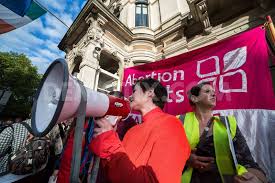
Róisín Ingle, Tara Flynn, and tens of thousands of fellow Irish Women.

abortion rights

Source: demotix.com

****

(First posted April 2015)

‘Share Your Story’

There was an invitation I didn’t receive every day. By receive, I mean what I stumbled on while frittering away time on the net, when one click inevitably led to another until the words stared back from the screen. Glared back with an arched brow. Like a gauntlet rolled across my eye-line landing abruptly in front of my finger-tips. Like my past tapping me on the shoulder having finally caught up after losing me on and off over the years. Here was my chance to turn around to have an encounter with what I never quite managed to shake off. Or share.

My story. Would I even have enough words to knead a story from them? Was the unsolicited offer of money from my friend the beginning of it? Or was it the umpteen tests that didn’t require the mandatory three minutes to be sure. Maybe it was the surreptitious tearing off of back pages from Marie Claire, or the relentless counting down of days and up of weeks in sheer disbelief on fingers that never ceased shaking; struggling to reconcile what was with what couldn’t possibly be. Could it? Was the return flight landing the end of it, or merely the middle, before the suspected infection landed me at a GP’s door? At the top of steps I’d never climbed before or since, and only out of necessity then because she had a reputation for being sympathetic.

And yet, all I can think of when confronted with this blank page is the red-headed girl who lay next to me in the recovery room.

I had a good ten years on her by then, though we were only counties apart. Same airline. Same stage. Booked in for the same procedure. I see her yet, pale, and anxious to return to her friend waiting at reception; both of us recovering on loungers as if on some exclusive spa retreat. To the manor born; dealing with our unborn.

Did she feel the same pain afterwards? Did she know to get Ibuprofen when nothing else worked? Did she wonder if the contractions she felt were like the labour she would not go through with this time? Did she go into combat against thoughts of never being given a second chance? Did she, too, go back to her daily grind immediately?  The relief from not colliding with anyone she knew in either airport still palpable…

I catch sight of her still in other teenagers. She would be 30 now. Two years older than what I was then. Old enough to have known better, they would say; whoever they are.

On that day, we became the ‘they’ that they draw sharp intakes of breath about in pulpits and pamphlets. We’ve been listening to stories about ourselves ever since. Stories I rarely recognise as my own.

The next day, I sat in a café, high on relief from being able to drink coffee again. Swinging down the Tottenham Court Road; buoyed up on secrecy, and a surreal certainty that nothing would ever be the same again, and everything would be exactly as it was before.

And here I am, almost fourteen years to the day later, the extent of the sharing of my story never having exceeded the number of people I can count on half of those same fingers. Until tonight.

I am participating in the ‘Share your abortion story’ initiative held in a discreetly disclosed location in Dublin City Centre. Final arrangements e-mailed, we are assured we can sign-in with a different name, if we so wish. I decline the option to be anyone else. It feels liberating to be me.

One by one, we take it in turn to read aloud over the next four weeks, retracing our steps along the choices we made; each story alive with the detail of exactly how it was then. Each reading followed by silence. Not the silence we are accustomed to when it comes to having our stories acknowledged, but a kind that lets pens glide across pages, delivering considered responses to mobilise us along our common quest to get it down. Pages gathered up to take away as we take our leave till next time.

The obliqueness of my story is evident to all. I have grown adept at disguising this chapter of my history over the years. The crushed heart I harboured at the time following the death of a seven year relationship is hidden from the listener; replaced by a hesitancy to share too much for fear it might trigger the slightest whiff of justification. I am not here for that. This much I know.

So what is my story exactly? It is one of fleeting comfort from unexpectedly finding myself in the arms of a friend at a time of rebound, one who celebrated the birth of his daughter with a former partner he reconciled with two months later. It’s a tale of sorrow at being marooned on a lonely place deserted from certainty, without the financial or mental means to make my own life work, never mind that of another. It’s the saga of a regrettable situation, but a decision taken without regret. It’s a one time thing, that happens a lot. It’s not the easiest one to tell, but one impossible to forget.

So why now after 14 years am I sharing it? There is no expiry date on the memory of our stories, or to the seeming right of others to assume copyright over what it was that we experienced, or what it was not. I answered the rap on my screen, opening it to the offer of a pen to take back the story I didn’t give permission for anyone else to tell. It was the first time I was asked.

For fourteen years, I have occupied a seat of nationally orchestrated silence at the foot of the altar of Official Ireland from where I am spoken about as though I am not in the room; where I am legislated for as if I were a headless surrogate for Mother Ireland and all her new-borns she will only commit to cherishing as children. Governed by unequivocal rulings that obscure the complexities of individual lives, and condemns grown women like me to fugitives from our own bodily and moral integrity; then onward to shameful silence on our return from Unofficial Ireland. Or the country commonly known as England. A nation that now counts my own daughter among its number. A new generation that appears destined to inherit the same unassailable, unsanctioned stigma presided over by the clerically-appointed custodians of their reproductive rights.

I believe that, like mine, their private lives should be sanitised of unauthorised public shaming, and all our confiscated wombs returned to us, stripped of competing graffiti and religious paraphernalia.

If the first casualty of war is truth, then sharing mine is a weapon I’m willing to fire. To begin to recover my lost voice; to reclaim the silence between the words never spoken. Until now.

With thanks to Angela Coraccio and fellow participants

The Mommy Wars: other voices

When I flick through various newspaper supplements, lifestyle magazines (ugh whatever the hell lifestyle is), or scroll down the latest quasi-guru infested websites, there seems to be no shortage of articles and commentary on the challenges of motherhood. On the face of it, this might appear a progressive trend only the most churlish would curl a lip at, but look closer and they read as postcards from a few select parenting resorts. Common though they may be among many.

When we talk about motherhood and work in these various spaces, it is often to the absence of voices of working class women being included. Despite hopes that this would change with the advent of cheaper access to the net, and a broader understanding of ‘balance’ and responsibility newsmakers surely have for contributing towards an equilibrium of comment with all the attendant tensions that would bring, it hasn’t. If anything, it has gotten worse.

There are too many trend stories about middle and upper middle class women and their dilemmas in the workforce/home dominating the waves. The validity of their experiences, and the right to unpick them both individually and collectively, is a given. But to many, and across much of the media, it cements a disturbingly singular narrative and the face of modern parenting in the Irish workplace. And this is worrying for everyone.

I don’t believe ordinary middle class and upper middle class women intentionally seek to exclude the experiences of working class women, or single mothers, or mothers from minority communities; but the narrow parameters around pat concepts we accuse the media of lazily drumming up, clearly do.

We’re all familiar with the routine by now. The mainstream “mommy wars” pits two homogeneous groups of women from broadly similar backgrounds against each other. The complexities of balancing workplace struggles, retaining personal identity, sanity, and a sense self-worth against childcare options, are reduced to notions of ‘choice’. Combined with boiled down statistics from a proliferation of (often dubious) studies conducted exclusively with a cohort of women from ‘professional’ sectors, all nuance is lost. Respecting personal choice as a response is all the rage. Add in negative equity and crippling childcare costs, and the cheap argument is rounded out into one that is null and void, where we all essentially just get along and support one another.

Buried below all of this, are the experiences of swathes of mothers who are unemployed for other reasons, or who work in the retail, caring, and catering sectors struggling to put together a living wage. The challenges they face in securing and paying for proper childcare are immense. It’s up there with securing sustainable work. And making the subsistence pay stretch. Low-income leads to poor physical health, poor mental health, inadequate diet, risky consumer choices, lack of opportunities to broaden progression routes within the training and work-force, and all the other by-products of poverty that don’t need spelling out here. The mainstream Mommy Wars excludes this narrative. The Mommy Wars exclude the need for everyone to push together, not just on the need for mutual respect, but for economic justice for other mothers. For fair wages. What might appear as a media-manufactured instrument of a fictional war, creates another barrier for those further down the line to battle against. Limiting responses to the Mommy Wars with proof of camaraderie among middle class women inadvertently drowns out those voices who are not.

In the main, mothers from every background are contending with busy lives and juggling a multitude of tasks to keep themselves and their family on the straight and narrow. They have enough to do. But it is unfortunate, that in on-line discussions concerning child and family nutrition, and other parental “choices”, the frequency with which choices of others are ridiculed, and certain women shamed, is becoming ever more apparent. Even from those who in another breath lament the existence of the phoney mommy wars while calling for respect and understanding.

The sugar industry preys on the paltry wages of poor mothers and works in an insidious way. And while breastfeeding might currently be the preserve of “educated” women, the self-satisfaction often accompanying the reporting of one’s commitment to it, while politely wagging fingers at those who do not, is at best futile. More than that, these discussions characterise the Mommy Wars of a particularly ugly kind. One in which those whose actions being challenged don’t have recourse to comment. Not in on-line fora, not on parental website articles, and certainly not in the national press.

Education brings with it a number of responsibilities as well as advantages. Continuing to educate ourselves on the experiences of everyone is surely one that comes with learned territory. We’re sophisticated enough to engage with the issues of all women.