An Easter rising

‘Share Your Story’

There was an invitation I didn’t receive every day. By receive, I mean what I stumbled on while frittering away time online, when one click inevitably led to another until the words stared back from the screen. Glared back with an arched brow. Like a gauntlet rolled across my eye-line landing abruptly in front of my finger-tips. Like my past tapping me on the shoulder having finally caught up after losing me on and off over the years. Here was my chance to turn around to have an encounter with what I never quite managed to shake off. Or share.

My story. Would I have enough words to knead one from them? Was the unsolicited offer of money from my friend the beginning of it? Or was it the umpteen tests that didn’t require the mandatory three minutes to be sure. Maybe it was the surreptitious tearing off of back pages from Marie Claire, or the relentless counting down of days and up of weeks in sheer disbelief on fingers that didn’t cease shaking; struggling to reconcile what was with what couldn’t possibly be. Could it?

Was the return flight landing the end of it, or merely the middle, before the suspected infection landed me at a GP’s door? At the top of steps I’d never climbed before or since, and only out of necessity because she had a reputation for being sympathetic.

Yet, all I can think of when confronted with this blank page is the red-head girl who lay next to me in the recovery room.

I had a few years on her, though we were only counties apart. Same airline. Same stage. Booked in for the same procedure. I see her yet, pale, and anxious to return to her friend waiting at reception; both of us recovering on loungers as if on some exclusive spa retreat. To the manor born; dealing with our unborn.

Did she feel the same pain afterwards? Did she know to get Ibuprofen when nothing else worked? Did she wonder if the contractions she felt were like the labour she would not go through with this time? Did she go into combat against thoughts of never being given a second chance? Did she, too, go back to her daily grind immediately?  The relief from not colliding with anyone she knew in either airport still palpable…

I catch sight of her still in other teenagers. She must be nearing 30 now. Not far off what I was then. Old enough to have known better, they would say; whoever they are.

On that day, we became the ‘they’ they draw sharp intakes of breath about in pulpits and pamphlets. We’ve been listening to stories about ourselves ever since. Stories I rarely recognise as my own.

The following day, I sat in a café, high on relief from being able to drink coffee again. Sauntering down the Tottenham Court Road; buoyed up on secrecy, and a surreal certainty that nothing would ever be the same again, and everything would be exactly as it was before.

Here I am, years later, the extent of the sharing of my story never having exceeded the number of people I can count on half of those same fingers. Until tonight.

I am participating in the ‘Share your abortion story’ initiative held in a discreetly disclosed location in Dublin City Centre. Final arrangements e-mailed, we are assured we can sign in with a different name, if we so wish. I decline the option to be anyone else. It feels liberating to be me.

One by one, we take it in turn to read aloud over the following four weeks, retracing our steps along the choices we made; each story alive with the detail of exactly how it was then. Each reading followed by silence. Not the silence we are accustomed to when it comes to having our stories acknowledged, but a kind that lets pens glide across pages, delivering considered responses to mobilise us along our common quest to get it down. Pages gathered up to take away as we take our leave till next time.

The obliqueness of my story is evident. I have grown adept at disguising this chapter of my history over the years. The crushed heart harboured following the death of a seven year relationship hidden from the listener; replaced by a hesitancy to share too much for fear it might trigger the slightest whiff of justification. I am not here for that. This much I know.

So what is my story exactly? It is one of fleeting comfort from unexpectedly finding myself in the arms of a friend at a time of rebound. It’s a tale of sorrow at being marooned in a lonely place deserted from certainty, without financial or mental means to make my own life work, never mind that of another. It’s the saga of a regrettable situation, but a decision taken without regret. It’s a one time thing, that happens a lot. It’s not the easiest one to tell, but one impossible to forget.

So why am I sharing it now? There is no expiry date on the memory of our stories, or to the seeming right of others to assume copyright over what it was that we experienced, or what it was not. I answered the rap on my screen, opening it to the offer of a pen to take back the story I didn’t give permission for anyone else to tell. It was the first time I was asked.

From girlhood, I have occupied a seat of nationally orchestrated silence at the foot of the altar of Official Ireland from where women are spoken about as though we are not in the room; where we are legislated for as if headless surrogates for Mother Ireland and all her new-borns she only half-heartedly commits to cherishing. Governed by unequivocal rulings that obscure the complexities of individual lives, and condemns grown women to fugitives from our own bodily and moral integrity; then onward to shameful silence on our return from Unofficial Ireland: England.

This nation now counts my own daughter among its number. A new generation appears destined to inherit the same unassailable, unsanctioned stigma presided over by the clerically-appointed custodians of their reproductive rights.

I believe that, like mine, their private lives should be sanitised of unauthorised public shaming, and all our confiscated wombs returned to us, stripped of competing graffiti and religious paraphernalia.

If the first casualty of war is truth, then sharing mine is a weapon I’m willing to fire. To begin to recover my lost voice; to reclaim the silence between the words never spoken. Until now.

With thanks to Angela Coraccio and fellow participants

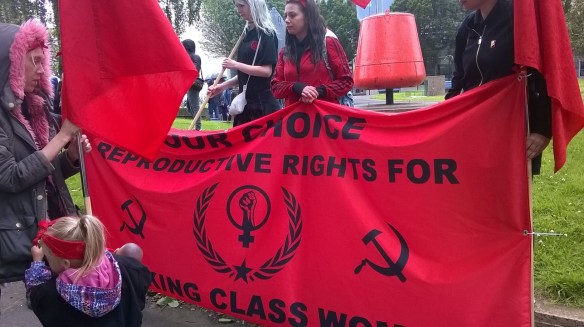
Children of the revolution

“Participants in last week’s pro-choice march hang signs around children’s necks proclaiming, “I was a chosen child.” The implications are chilling. “Chosen” has surface connotations of being special, but also the cold wind whispering in your ear: you could have just as easily not been chosen. Your siblings, your flesh and blood, may not have been chosen and therefore are absent forever from your life. Such a slogan screams that adults are all-powerful. They have the right to exclude others from even being defined as human.”

Breda O’Brien, Irish Times Sat 1/10/16

I wondered when the subject of children on protest marches would arise. More specifically, the subjective value-judgements commentators inevitably attach to it. Breda might’ve been left cold by the perceived connotations of the gesture, as is her wont; I just thought it was extraordinarily naff. But I’m sure she’d expect nothing less from an irresponsible pro-choicer like myself who brought her own daughter on the march last year.

She continues…

“Children cannot rationalise abortion in the way adults can. They cannot rationalise taking away a life as a solution.”

As statements of fact, the first will likely be met with broad agreement by anyone who has ever spent a few minutes of their lifetime dabbling in logic. The second will prompt many to ask for clarifications on the meaning of life, whether that includes the life of a sentient woman, the solution to what exactly, and other plentiful well-worn question marks frequently posed by my 4 year-old and her mates over play-doh.

Breda’s contention is not that children shouldn’t be brought on marches  – she brought her own on pro-life rallies – it’s that pro-choice marches are essentially an exercise in compromising the emotional security of those children attending. Where the use of such slogans as ‘chosen child’ is an unequivocal demonstration of how their mother’s love is conditional, and there but for the almighty power of her (presumably) blithe judgement, their own lives might very well have been taken away before they began.

Tell me about it, Breda. Sure our wee one has been milking that one for years, and will continue to do so until it dawns on her around 13 that she didn’t actually ask to be born.

“No parent loves perfectly, but babies bring out a fierce protectiveness in us. The urge to protect the weakest and most helpless is primal. Or at least it used to be.” 

Or at least it is for us pro-life parents, in short. As a pro-life protesting parent, Breda is satisfied with the phased exposure to the principles of the pro-life movement undertaken with her own children. Pro-life protestors, it would seem, have a monopoly on ensuring responsible engagement of children in forms of protest.

“I told them that abortion was a word that they had to trust me to worry about and not to explain until they were much older. “

I’m not sure I feel so confident. When it comes to protecting the innocence of my own girl, and balancing that with the cultivation of a sense of justice and an incremental introduction to the complexities and messiness of life, there is much I won’t be able to guard her from. But such is life.

In time, she will come to learn there are few areas in life that can be unequivocally defined by a single moral perspective. That those holding competing views will always be the last to see their own hypocrisy. And, just as Breda marches alongside children brandishing placards showing foetal remains; the rest of us take our place next to our own diversity of bedfellows and march onward in the hope of reaching a fair destination.

For now, I’m reasonably certain that instilling an awareness of the existence of public disgruntlement, unhappiness among women about the rules that govern them, and their corresponding entitlement to use the public highway to highlight that, will not compromise our girl’s sense of security. She’s been doing it effectively in the hallway since the time she could walk.

children-marching

What do we want?

Our mothers to be trusted

When do we want it?

Er can we have our crisps now?

People before prophet

rally

Socialists Worked in solidarity with

Queen’s in communion with

Green Partiers flanked by Kerry

Pro-Choicers who marched alongside

Belfast Feminists who banged to the beat of

hearts of Anarchists who roared over

soaring voices of Parents chanting

‘Hey, Hey, Mister, Mister,

Get your laws off our sister’

Belfast, Saturday 2nd July 2016

belfast 3

Say what?

Many’s the conversation I’d love to have overheard but didn’t so I’m forced to undertake some guesswork instead. To fill in some essential blanks as it were.

Example One:

On driving by a house with a pair of gigantic stone Irish wolfhounds aloft pillars either side of a 10 foot gate (digital keypad on the right) at the foot of a driveway leading to a…standard 1950’s bungalow. Child of Prague in the porch window optional.

Picture the scene:

A newly retired couple – let’s call them Mary and Tom – are strolling through the garden centre of a Sunday…

Mary: What about one of those windmills like the Cassidys have?

Tom doesn’t hear her because he got distracted by the joinery in the garden sheds ten feet back without her realising. He can’t help himself. He feels The Dark Stare and looks up to squint at whatever she’s pointing at.

Tom: Whatever you think yourself. I’m easy.

M: Sigh

T: What about this fountain-y yoke?

M: Mmmm. It’s OK. Would it not be hard to keep clean? *strolling on* Wait, what about these? *points to set of stone wolfhounds before going over to caress them*

T: They’re a bit big, are they not?

M: *reads label* There’s 30 per cent off them. Sure they match the gable wall.

Example Two:

Leaning back on the dentist’s chair trying to respond to his  considered questions while his fingers are shoved into my wide-open gob.

Picture the scene:

Young Sean at 17 filling in his CAO form…

Dad looking over his shoulder: What’s that you have down as your first choice?

Sean: Sociology in Cork

Dad: That’s hardly a career. What did Mammy say?

S: She said to choose whatever would make me happy

D: Mammy? *footsteps towards kitchen*

One hour later..

Mammy: But you’ve always been good at science. Would you not just pick one to keep him happy? What about medicine?

S: But I’m queasy, Ma. Remember that time I fainted in biology when they showed the video of that beatle trying to roll a ball of earth backwards up a hill.

M: That was because you were dehydrated from playing tennis at lunch beforehand.

S: Was it? *scratches head*

M: OK, well, what about dentistry?

S: Yeah, right, so I can what – fool around with the laughing gas?

M: There you go! Dentistry it is.

Example three:

On hearing a teenager in Northern Ireland was reported to the police by her flatmates for procuring abortion pills on-line.

Picture the scene…

Two flatmates – let’s call them Hannah and James – suspect their other flatmate has induced an abortion with pills bought over the net. The contents of a black bag lead them to believe she has followed through with her intent. Despite having only recently moved in with them, she discloses she is pregnant and hopes to raise enough money to enable her to travel to the UK for an abortion. She doesn’t, so orders the pills instead.

Hannah: *looks blank*

James: *looks blank*

H: What do you think we should do?

J: *shrugs* Check if she’s OK? whether she needs any help or support? Or we could just mind our own business.

Five minutes silence later…

H: What would Jesus do?

J: Mmmmm *contemplates question* Does it matter that my God is different to your God?

H: Not if we’re thinking the same thing

In unison: Call the PSNI?

*high five*

Did you read Róisín yet?

A common mate call among pairs of mothers and daughters echoed along our national phone network on any given weekend. An Ireland-shaped matrix of relationships that leads them to find in her columns those common touchstones on the pitfalls and playfulness of life. A recurring item on the agenda for the weekly weekend catch-up. Invariably, it reminds one of the other, or of themselves together. Distilling what they’ve been “saying all along” into ways they’ve never heard put, or possibly as compassionately or honestly, before.

As a bridge between generations, my Mother and I have been tip tapping back and forth over her columns to each other for years. Plucking out similar calamities and falls from social grace for a duet of laughter. And letting a few seconds of silence speak for themselves when it comes to more fatal falls of the heart and good intentions. As an interpreter of the hard stuff between generations of the same blood, Róisín’s been doing it pro bono for as long as I can remember.

Last week was no different.

“Did you read Róisín yet?”

It’s rare for both of us to be on the same page. The other is always just on the brink of sitting down to do so. And there’s her crossword and Sudoku addictions to attend to first.

Last week was no different.

“I’m just about to sit down. But I heard her on Marian. That took some guts”

“It did, yeah”

But last week was different. Instead of waiting till the next call for her to catch up, I felt an unpremeditated urge to keep going.

“Ma?”

“Yeah?”

The few seconds of silence steeled us both.

“What is it?”

“I had an abortion, too, Ma. I just never found the right time to tell you”

Her sigh of relief audible.

“Well, isn’t it lovely that it was Róisín who helped you to tell me?”

A woman who has been giving us both permission to talk as women for years . The significance was not lost on either of us.

In solidarity with..

Róisín Ingle, Tara Flynn, and tens of thousands of fellow Irish Women.

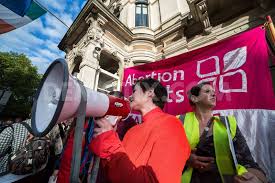
abortion rights

Source: demotix.com

****

(First posted April 2015)

‘Share Your Story’

There was an invitation I didn’t receive every day. By receive, I mean what I stumbled on while frittering away time on the net, when one click inevitably led to another until the words stared back from the screen. Glared back with an arched brow. Like a gauntlet rolled across my eye-line landing abruptly in front of my finger-tips. Like my past tapping me on the shoulder having finally caught up after losing me on and off over the years. Here was my chance to turn around to have an encounter with what I never quite managed to shake off. Or share.

My story. Would I even have enough words to knead a story from them? Was the unsolicited offer of money from my friend the beginning of it? Or was it the umpteen tests that didn’t require the mandatory three minutes to be sure. Maybe it was the surreptitious tearing off of back pages from Marie Claire, or the relentless counting down of days and up of weeks in sheer disbelief on fingers that never ceased shaking; struggling to reconcile what was with what couldn’t possibly be. Could it? Was the return flight landing the end of it, or merely the middle, before the suspected infection landed me at a GP’s door? At the top of steps I’d never climbed before or since, and only out of necessity then because she had a reputation for being sympathetic.

And yet, all I can think of when confronted with this blank page is the red-headed girl who lay next to me in the recovery room.

I had a good ten years on her by then, though we were only counties apart. Same airline. Same stage. Booked in for the same procedure. I see her yet, pale, and anxious to return to her friend waiting at reception; both of us recovering on loungers as if on some exclusive spa retreat. To the manor born; dealing with our unborn.

Did she feel the same pain afterwards? Did she know to get Ibuprofen when nothing else worked? Did she wonder if the contractions she felt were like the labour she would not go through with this time? Did she go into combat against thoughts of never being given a second chance? Did she, too, go back to her daily grind immediately?  The relief from not colliding with anyone she knew in either airport still palpable…

I catch sight of her still in other teenagers. She would be 30 now. Two years older than what I was then. Old enough to have known better, they would say; whoever they are.

On that day, we became the ‘they’ that they draw sharp intakes of breath about in pulpits and pamphlets. We’ve been listening to stories about ourselves ever since. Stories I rarely recognise as my own.

The next day, I sat in a café, high on relief from being able to drink coffee again. Swinging down the Tottenham Court Road; buoyed up on secrecy, and a surreal certainty that nothing would ever be the same again, and everything would be exactly as it was before.

And here I am, almost fourteen years to the day later, the extent of the sharing of my story never having exceeded the number of people I can count on half of those same fingers. Until tonight.

I am participating in the ‘Share your abortion story’ initiative held in a discreetly disclosed location in Dublin City Centre. Final arrangements e-mailed, we are assured we can sign-in with a different name, if we so wish. I decline the option to be anyone else. It feels liberating to be me.

One by one, we take it in turn to read aloud over the next four weeks, retracing our steps along the choices we made; each story alive with the detail of exactly how it was then. Each reading followed by silence. Not the silence we are accustomed to when it comes to having our stories acknowledged, but a kind that lets pens glide across pages, delivering considered responses to mobilise us along our common quest to get it down. Pages gathered up to take away as we take our leave till next time.

The obliqueness of my story is evident to all. I have grown adept at disguising this chapter of my history over the years. The crushed heart I harboured at the time following the death of a seven year relationship is hidden from the listener; replaced by a hesitancy to share too much for fear it might trigger the slightest whiff of justification. I am not here for that. This much I know.

So what is my story exactly? It is one of fleeting comfort from unexpectedly finding myself in the arms of a friend at a time of rebound, one who celebrated the birth of his daughter with a former partner he reconciled with two months later. It’s a tale of sorrow at being marooned on a lonely place deserted from certainty, without the financial or mental means to make my own life work, never mind that of another. It’s the saga of a regrettable situation, but a decision taken without regret. It’s a one time thing, that happens a lot. It’s not the easiest one to tell, but one impossible to forget.

So why now after 14 years am I sharing it? There is no expiry date on the memory of our stories, or to the seeming right of others to assume copyright over what it was that we experienced, or what it was not. I answered the rap on my screen, opening it to the offer of a pen to take back the story I didn’t give permission for anyone else to tell. It was the first time I was asked.

For fourteen years, I have occupied a seat of nationally orchestrated silence at the foot of the altar of Official Ireland from where I am spoken about as though I am not in the room; where I am legislated for as if I were a headless surrogate for Mother Ireland and all her new-borns she will only commit to cherishing as children. Governed by unequivocal rulings that obscure the complexities of individual lives, and condemns grown women like me to fugitives from our own bodily and moral integrity; then onward to shameful silence on our return from Unofficial Ireland. Or the country commonly known as England. A nation that now counts my own daughter among its number. A new generation that appears destined to inherit the same unassailable, unsanctioned stigma presided over by the clerically-appointed custodians of their reproductive rights.

I believe that, like mine, their private lives should be sanitised of unauthorised public shaming, and all our confiscated wombs returned to us, stripped of competing graffiti and religious paraphernalia.

If the first casualty of war is truth, then sharing mine is a weapon I’m willing to fire. To begin to recover my lost voice; to reclaim the silence between the words never spoken. Until now.

With thanks to Angela Coraccio and fellow participants

5 ways The Rose of Tralee is like Irish abortion laws

1. The women are forced to go through a rigorous process of scrutiny before presenting for adjudication in front of an expert panel

2. The two-dimensional portrayal of women as a homogenous group devoid of all complexities in a bid to uphold the official pageantry

3. There’s usually an irrepressible man dressed in black and white dominating the airwaves with displays of parochial eejitry

4. Frequent cries about the need to “protect our values and our culture” , and the incurable propensity towards propping up long-expired representations of the past

5. It doesn’t exist anywhere else in the world

Stowin’ away the time

We went on holidays last week.  We’re very this season that way. Self-catering in a holiday house by the sea. By self-catering, I mean dining out every night; by holiday house, I mean an early introduction to retirement-home living where the furniture is designed more with orthopaedic support in mind than extravagant lounging. All right-angled austerity with Mary Kennedy appearing as her disturbingly inoffensive self on every available television channel.

I took one look around and made a mental inventory of the various irritations I was determined to complain about (lack of WiFi, filth on the curtains, lack of WiFi, dirty bathroom, lack of WiFi). No free shower caps, mini shampoos, or sewing kits to gleefully stash, so I had to fill the instant gratification vacuum somehow. I may have deployed that term so beloved of wimps  (“mark my words”), which had deflated to a crumpled up shadow of its former self by the week’s end. I waved goodbye to the owner in manner of lowly lickarse to departing dignitary on pulling out.

I mistakenly typed “pulling off” there initially. That’d be the sleep deprivation from the ward bed talking, and the snoring from my brother who we invited along for a few nights and had us re-negotiating our marriage vows at 4am. I returned embarrassingly overdrawn on my husband’s flexibility. I’m still doing the pitiful forgive-me face; often confused with the equally pitiful I’m-a-fucking-idiot face. Sure, you’ll have that.

Bleary-eyed and idle, I mooched around till the beachside café coolly flip-flopped its way into the breach with free WiFi, forcing me to abandon my habit of  avoiding surfer hipster types (not indigenous to where I live), and the news black-out I was banking on and bragging about before we left.

The grimness cascaded down daily. Caesarean Section at 26 weeks. James Foley. Suspected Ebola Case. Pat Kenny set to return to our TV Screen. Cliff Richard fans vow to get their man back in the charts. Where will it end? Morph reveals dark world of Tony Hart?

One of the other thousands of ways I like to test the limits of my husband’s patience is to engage him in a game of guess the potential song the producers of Reelin’ In the Years will marry with a moment from the here and now. The soundtrack must be released from the featured year and fit the footage.

‘Mr. Sun, Sun, Mister Golden Sun’ was automatically disqualified for failing to meet the first part of those criteria.  I made a unilateral decision and settled on visualising scenes of the follow-up protests of women on loudspeakers segueing into follow-up news clips of politicians clogging the silence with cowardice and back again to the strains of Seasons by Future Islands.

Seasons change, and I tried hard just to soften you
The seasons change, but I’ve grown tired of tryin’ to change for you
Because I’ve been waiting on you
I’ve been waiting on you
Because I’ve been waiting on you
I’ve been waiting on you

As it breaks, the summer awaits
But the winter washed what’s left of the taste
As it breaks, the summer awaits
But the winter craved what’s lost
Crave what’s all gone away

People change, even though some people never do
You know when people change
They gain a piece but they lose one too
Because I’ve been hanging on you
I’ve been waiting on you
Because I’ve been waiting on you
I’ve been hanging on you

As it breaks, the summer awaits
But the winter washed what’s left of the taste
As it breaks, the summer awaits
But the winter craved what’s lost
Crave what’s all
Crave what’s all gone away
‘Cause I’ve been waiting on you

https://www.youtube.com/watch?v=1Ee4bfu_t3c

All other suggestions welcome.

Top 5 ways The Rose of Tralee competition is like Irish abortion laws

1. The women are forced to go through a rigorous process of scrutiny before presenting for adjudication in front of an expert panel

2. The two-dimensional portrayal of women as a homogenous group devoid of all complexities in a bid to uphold the official pageantry

3. There’s usually an irrepressible man dressed in black and white dominating the airwaves with displays of parochial idiocy

4. Frequent cries about the need to “protect our values and our culture” , and the incurable propensity towards propping up long-expired representations of the past

5. It doesn’t exist anywhere else in the world

Birgitte Nyborg v Lucinda Creighton

Clare. Just like I pictured it; skyscrapers and everything. Well, a supremely cool lighthouse in Loop Head, anyway. And, Gee, those Cliffs of Mo-hair sure are awesome. The place will always have a piece of my average-sized heart. And possibly some disturbing reverb from my occasional roars at Lucinda Creighton on the box.

Our visit last year coincided with the sleep-deprived government debates on the implementation of Ireland’s Protection of Life During Pregnancy Bill. Based on the 1992 Supreme Court Ruling, it allows for limited rights to abortion on the grounds of the threat to the life of the woman, and the threat of suicide by the woman.

After months of protracted hearings and debate, and days of will she or won’t she, the Bill was finally passed and Lucinda was shown the door from her parliamentary party. The one she took great care to remind us, repeatedly, she was forced to prise open and slam shut with the might of her own unrivalled courage and conviction.

Two developments collided on the venn diagram of public opinion to produce her magical beatification.

Firstly, Creighton was upfront and unequivocal in her opposition to provision for the threat of suicide.  A high profile junior minister challenging party directive. Her beliefs aired in adherence with the availability of free speech. But by the time the vote came round, Creighton was not the last opponent standing. Six of her colleagues were expelled from Fine Gael following their defiance of party policy by voting against it.

Secondly, the media, having cynically played Creighton’s resoluteness off against similar concerns from her female colleagues, soon forgot the other 24 Dáil members who voted against the Bill. Focus rapidly zoomed in on Michelle Mulherin’s U-turn as evidence of a lack of sufficient moral conviction and selfish careerist motives. In turn, the weight of Lucinda’s unyielding convictions won her the higher moral ground.

With the exception of Vincent Browne, this narrative appeared to go unchallenged by the mainstream media. Over the following days, Lucinda’s bravery frontloaded the headlines. By this stage, it was Lucinda who was providing most of the commentary from what appeared to be a temporary altar built on the shoulders of cameramen and microphones. A new secular saint was born.

Danish TV drama is not a clinically approved petri-dish for lab analysis of Irish politics, but like much of popular culture, it has its usefulness in showing us something about how the world works. Watching Borgen over the year since these queasy events has helped shaped a few questions that were achingly absent during the carnival.

Birgitte Nyborg is the impossibly charismatic leader of The Moderates, a centre-left party occupying the ruling seat in the governing coalition. As PM of Denmark, Nyborg presides over the usual dilemmas pertaining to a range of domestic (welfare reform, criminal justice, immigration) and international (rendition flights, international trade, war and humanitarian intervention) affairs. Negotiating policy is based on skilfully balancing trade-offs between those ideologies among her coalition partners and opposition, with the best possible outcome for the common good of the Country and its citizens. Or pragmatism, in short. Backed up by commendable communication skills. It is classically Danish in its leftist leanings. To illustrate the complexity of fixed morals in the political bear pit of government, Nyborg emerges as an exemplar of a liberal idealist forced to surrender to seemingly unpalatable compromises.

Negative public opinion against her intensifies the longer she fails to bow to internal pressure to upgrade spend on military hardware in the wake of Danish peacekeeping casualties in Iraq. She caves in. Proposed early retirement age leaps up and down as the policy pieces are moved around the chess board. They settle on a half-way year. Business oligarchs are courted and double-bluffed. Everyone’s a winner. The cracks in capitalism are assumed, but the purest form of liberal policies prove an ineffective panacea alone.

More than once, Nyborg is accused of undermining her party’s ideals and the lines between political necessity and retention of power at all costs become blurred. Are the risks she takes to pitch for the role of mediator between two warring African countries indicative of the vanity and glory-seeking many accuse her of, or her fundamental humanitarian impulses she cannot ethically ignore? Probably both.

Was Michelle Mulherin’s U-turn a case of outright redundancy protection, a simple case of toeing the party-line, or surrendering to the will of the people?

Was Lucinda’s steely reserve in the face of party discipline purely a case of moral conviction at a heavy price, a self-serving move that elevated her public profile, or an exercise in placing personal conviction above consensus and the will of the electorate?

We’ll never really know. Partly because the prevailing responses to these questions came only from Lucinda.

Fine Gael was upfront in its coalition deal with its governing partners. The Bill was to be passed. It was informed by a Court ruling mandated by the electorate in a referendum 20 years previously. Time for a cabinet to do its work for the common good long built on electoral consensus. A no-brainer. The issue of conscience a moot point.  As Vincent Browne emphatically pointed out throughout – abortion is already available to Irish women if they have sufficient means, and an acceptable form of identification for Ryanair, to have one. Nyborg would credit the electorate and her cabinet with more cop than wilful border blindness and hypocrisy.

At no point during the media spectacle was Lucinda asked to consider the worth of the moral convictions of those who voted as a matter of conscience. Those ‘brave’ Dáil members who used their conscience as an instrument to balance personal and party ideologies with the best possible outcome for the Country and its citizens. Pragmatism, in short. The stuff that progressive modern democratic politics is based on. Not parish pump politics in which progress is stifled or buoyed up by the mettle of individuals rarely tested. Nyborg hails from a tradition of the former; Ireland is built on the latter. The implementation of the Bill presented a break-away moment when fresh realities bubbling below the surface for two decades would finally flower. When notions of bravery and conviction would be re-defined.

As an individual who felt stifled by her party directive, Creighton was free to declare her position, bare her fangs, and bow out. As an accidental arbiter on standards of political conscientiousness, it was a role she cheerfully grabbed from a willing media. Nyborg would not have been arrogant enough to accept such a misplaced honour.

That any of these women share similar genitalia should be neither here nor there, but stories of halos and villains in battles involving wombs are always easier to write when women are the chief protagonists. As politicians, all of them, like their colleagues, and the parties to which they belong, are weak to overtures from compromise, party leaders, personal gain, and the will of the people.

Would the woman with the most courage of her moral convictions please stand up?

You can all sit down now. And Lucinda, please close the door gently behind you on your way out this time.