Divorcing union jack

Lately we’ve been taking short-cuts through back-streets to shave a few minutes off the lunch-run. All in an effort to get her to the minder then back to work on time. So we turn left instead of right; left again, another left, then right. Past the corner shop with perennially balding shelves, then onwards under the bunting that salutes us over speed-ramps through to the main road.

Against every instinct, I tell her the locals must be having a party when she presses me on the union jacks overhead. Wrong answer, she asserts. They’re having a disco. I guess she’s not far wrong, if the disco is a slow-set in a draughty school hall somewhere in the early ’80s. In many respects, the town is not unlike the equivalent of two species awkwardly lined up against opposing walls. One too paralysed by fear to ask the other out; the other convinced they’ll never be asked. While everyone knows The Specials’ Ghost Town is impossible to dance to anyway.

With eyes still misty from centenary celebrations over the border, I’ve been living down to stereotypical behaviour expected of me by taking a great deal of time to think about What It All Means. This Irishness. Of ours. Of mine. And my Mary Robinson Claw™ is still very much up in the air.
hand

Member of the Mnás gives the fingers

I’ve gone through the mandatory motions. I reverently stroked my chin to  Minister for History, Diarmuid Ferriter; shuddered at the prospect of Sean Gallagher presiding over poetic state-of-the-nation addresses; had odd where-were-you-when-Riverdance-was-first-performed conversations following its comparison to Centenary. And before you ask, yes, I heaved a sigh of relief that Onob resisted urges to swing the arms of Martin and Enda aloft to usher elusive peace to The Dail as only a true messiah can.

I tried to be a better begrudger. But alas, I am no further forward in cobbling together any convictions. I shall probably defrost the Centenary as I do Bjork albums – ambivalent at first, then raving about it a year later.

Perhaps it was to be expected given my internalised Irish O’Phobia. The same syndrome that had me giving wide berth to Irish bars abroad; and enclaves of diaspora during my brief years in London. Not the upwardly, neutral-accented, confident generation of new; but those of old who jived at the crossroads of survival. I deliberately chose not to work with the ‘disadvantaged’ London Irish ‘community’.  Rightly or wrongly, they provoked frustration and sadness in profuse and equal measure. Sadness that many were exported against their will; frustration with a variety of elements that kept them hemmed in to the margins. It was an emotional push-pull operation of delicate avoidance. I was unable to face the dark side of our soul, expressed through various valves: their language,  shorthand, the veil of silence, the melancholic shadow of God knows what. I couldn’t escape them however. I heard their stories daily through the mouths of Brazilians, Poles, Columbians. All sharing the status of fugitives from their homelands. United in isolation and loneliness with a nostalgic yearning for an idealised nation while in pursuit of better. Small surprise the Irish are held aloft the international shoulder, they had the English language to help accelerate integration.

Throughout these neighbourhoods, the cultural clock stopped a few generations back. Each summer I could hear the trad bands on Peckham Park at the annual Irish festival. What was a celebration of ‘Irishness’ seemed to me a bizarre exercise in time travel. Some frustrations are impossible to hang anywhere because that’s just the way it is. The interaction of emigration with time. Traditional modes of cultural expression survive unevolved, enabling the exiled to huddle together on foreign land, but eventually alienating them from their home soil. Too often it seemed they were suspended in a cultural time-warp. The commonly reported disorientation felt by returned ex-pats pointed to this. Many retreated back to their host eventually. One version of their tale suggested disdain for the lamentable loss of ‘traditional values’, another… the unavoidable modernisation of a country, the cultural landscape of which was now fluid and beyond recognition. One interpreted in terms of attack, the other in less malevolent terms of change. The way it is.

There’s no doubt the Celtic Tiger era left many every which way at sea.  Alienation and mental health problems prevail yet remain largely ignored. Consistent poverty persists. However, they have always existed. Just like the attack on ‘traditional values’ has. As have the competing strains of ‘Irishness’ and what it means to be Irish. Independence propped up a cultural infrastructure vertically imposed by church and conservative elements of the state, and many Irish people have always felt at odds with a certain narrow notion of ‘culture’. Irishness is ultimately an exercise in self-definition; as broad as it’s long.

I don’t consider myself nationalist in the classic sense, but I am anti-colonial. I understand why the Irish language became politicised  but still break out in hives when trotted out for ridicule. I could listen to Iarla O’Lionaird all day, but  would rather overtake a session stuffed with air-punching patriotic songs. My heart stops watching hurling, but I could cheerfully burn Michael Flatley at both ends. I love reading about the women caught up in the Independence movement. But I would like to learn more about the United Protestant men before them. Many ‘Irish’ people have been overlooked in official history.

The idea of the Irish as a homogenous group sharing a common reverence for emblematic cultural cornerstones has always rankled. We only have to look to our silenced exiled writers of the past as evidence.  Embedded in this, the dominance – and struggle of – ‘national pride’. What do all those terms mean? Who defines them? And what aspects can be defended and why? One person’s lament for ‘traditional values’ is another’s dismissal for naively ignoring the much needed introduction of freedoms and fight for equality. It would be disingenuous to deny the prevailing doctrine when the period of ‘traditional values’ flourished. The establishment of an authentic moral code is an evolving process, progressed on a rights-based agenda. To have it colonised and shaped by institutions in the business of moral absolutes undermined the project of humanity itself. As we saw.

Ireland is at an interesting, if precarious, point. Time and Europe dragged it out of its monolithic conservatism. It just needs the balls to retain the favourable values of yore. That responsibility hinges on everyone. It necessitates recognition by the defenders of ‘traditional values’ of the legitimacy of diversity of opinion and identity. One of the more enlightening and optimistic days I had recently was spent in the company of a group of aging nuns.There’s a sentence I never imagined writing. They fiercely articulated the need to discard the singular thinking and championed the arrival of diversity, in all its guises. Even though it has always been here.

Modernisation isn’t an attack on traditional heritage; traditional heritage is not the full expression of Irishness. Listening to the Peckham parade didn’t fill me with sneer. It frustrated me that the continuum of Irish culture, traditional – and contemporary – couldn’t be captured. But here it is. And strands compete for eminence within it. Gaelic is still sniffed at by the urbanites. Many of them in turn suffer their own cultural superiority complex. Moreover, ‘Irish culture’ in the South has been given room to evolve as it hasn’t been vulnerable to attack. It hasn’t served to unite a minority through a rigid codified system of culture as it has in the North. The pace of the removal of homogeneity of ‘Irishness’ proceeds in different gears either end. Irishness played out differently for reasons that don’t need repeating.

Yet, it is in this context that this year’s St. Patrick’s Day Parade in Dublin was led by a student activist campaigning for the rights of those with disabilities; while in this town it was headed by prominent clergy and ‘nationalist’ politicians. The old guards haven’t gone away, you know. Another reminder of the gulf that persists between the ‘Irish’ on the island. Fractures that run parallel with the cultural divisions between broad sections of the local British and the other ‘British’.  The London Irish have more in common with their brethern up here where the cultural and clerical clock lags behind its Southern neighbour, and further still from those across the water. It is partly why ‘socialist’ Sinn Fein can sit with ease at the high table of Irishness alongside elite members of the clergy. Their ease with it mirrored by the anchoring of fundamentalist protestantism to the other tribe’s celebratory outings. It is why the status of women is not up for consideration by either extreme. It is why issues of equality and reproductive rights are forsaken. It is certainly a contributing factor in why some grown women lack the gumption to do anything but sublet their conscience and grass an unrepentent teenager to the cops a week after she induced  an abortion on her own.

Unlike the old London Irish, these devout Irish will not be flirted with by the Republic in a bid to woo them down ‘home’ for a reminisence date; and your average British man has as much in common with a bowler hat wearing marcher as he does a Morris Dancer. Indifference is probably the best either group can avail of.

And between them all sit the Northern Irish. A chequered, complex, hybrid entity. The Other. Under pressure to declare which team they’re going to play for when the Olympics come round. Southern commentators  can always been relied on to adopt a keen interest that only appears when the critical topic of sport arises.

And then there’s me, straddling both jurisdictions and never fully feeling a sense of belonging in either. Southern heart, Northern Soul. I am border. If home is a sense of belonging, then I belong best along the Donegal coastline at 60 miles an hour with the speakers pumping. It’s not very practical.

So I’m here. Hat laid North. For the foreseeable. Softer of vowel, eager to join forces with the Other. One of them, but never one of them. An insider outsider. Under pressure from my four-year old to guess which Michael Jackson song they’ll be playing at their disco.

****

He ordered two drinks and we adjourned to the side table of a bar overlooking Great Victoria Street.   

“You’re from Boston, right?”

“I work in Boston. I’m from New York”

“Big Irish interest in Boston, isn’t there? Keen to see peace break out all over here, I suppose.”

“You could say that”

He lifted his glass to me, swirling the half-finished drink. “It’s made nearby, I understand,” he said.

“Aye. Up the road. Bushmills. It’s popular with tourists”.

“I’ve had it before – but I have to admit it tastes better in Ireland”

“Like Guinness tastes better in Dublin. And stick to calling it Northern Ireland. Although you’ll hear variations. If you’re a Loyalist you’ll call it Ulster, if you’re a Nationalist you’ll call it the North of Ireland or the Six Counties, if you’re the British Government you call it the Province.”

“And what do you call it, Mr. Starkey?”

“Home”

From Divorcing Jack by Colin Bateman
Say what?

Many’s the conversation I’d love to have overheard but didn’t so I’m forced to undertake some guesswork instead. To fill in some essential blanks as it were.

Example One:

On driving by a house with a pair of gigantic stone Irish wolfhounds aloft pillars either side of a 10 foot gate (digital keypad on the right) at the foot of a driveway leading to a…standard 1950’s bungalow. Child of Prague in the porch window optional.

Picture the scene:

A newly retired couple – let’s call them Mary and Tom – are strolling through the garden centre of a Sunday…

Mary: What about one of those windmills like the Cassidys have?

Tom doesn’t hear her because he got distracted by the joinery in the garden sheds ten feet back without her realising. He can’t help himself. He feels The Dark Stare and looks up to squint at whatever she’s pointing at.

Tom: Whatever you think yourself. I’m easy.

M: Sigh

T: What about this fountain-y yoke?

M: Mmmm. It’s OK. Would it not be hard to keep clean? *strolling on* Wait, what about these? *points to set of stone wolfhounds before going over to caress them*

T: They’re a bit big, are they not?

M: *reads label* There’s 30 per cent off them. Sure they match the gable wall.

Example Two:

Leaning back on the dentist’s chair trying to respond to his  considered questions while his fingers are shoved into my wide-open gob.

Picture the scene:

Young Sean at 17 filling in his CAO form…

Dad looking over his shoulder: What’s that you have down as your first choice?

Sean: Sociology in Cork

Dad: That’s hardly a career. What did Mammy say?

S: She said to choose whatever would make me happy

D: Mammy? *footsteps towards kitchen*

One hour later..

Mammy: But you’ve always been good at science. Would you not just pick one to keep him happy? What about medicine?

S: But I’m queasy, Ma. Remember that time I fainted in biology when they showed the video of that beatle trying to roll a ball of earth backwards up a hill.

M: That was because you were dehydrated from playing tennis at lunch beforehand.

S: Was it? *scratches head*

M: OK, well, what about dentistry?

S: Yeah, right, so I can what – fool around with the laughing gas?

M: There you go! Dentistry it is.

Example three:

On hearing a teenager in Northern Ireland was reported to the police by her flatmates for procuring abortion pills on-line.

Picture the scene…

Two flatmates – let’s call them Hannah and James – suspect their other flatmate has induced an abortion with pills bought over the net. The contents of a black bag lead them to believe she has followed through with her intent. Despite having only recently moved in with them, she discloses she is pregnant and hopes to raise enough money to enable her to travel to the UK for an abortion. She doesn’t, so orders the pills instead.

Hannah: *looks blank*

James: *looks blank*

H: What do you think we should do?

J: *shrugs* Check if she’s OK? whether she needs any help or support? Or we could just mind our own business.

Five minutes silence later…

H: What would Jesus do?

J: Mmmmm *contemplates question* Does it matter that my God is different to your God?

H: Not if we’re thinking the same thing

In unison: Call the PSNI?

*high five*

Grave robbers and revisionists

It’s January 2016, so it must be time for…

Anti-Sinn Féin sentiment to hit apoplectic proportions across the mainstream media and middle-classes. The only thing more nauseating than the self-serving antics of the All-Ireland version of the politburo is the hysterical outcry The Party provokes among those respectable folk forced to suffer the riff-raff.

Specifically, the cynical self-serving outcry that has them holding their noses as they take their seats next to them in the pews of Leinster House; all the while conveniently ignoring their own role in sanctioning the same bunch of “grave-robbers and revisionists” to dominate the high-table of decision-making in the North through endorsement of the Good Friday Agreement.

It’s the sort of hypocrisy that enjoys persistent re-profiling into a gesture of such messianic proportions in the re-telling it’s a wonder the entire Republic weren’t awarded the Nobel Peace Prize. Sure, those wee northerners would’ve obliterated each other had the political elite not stepped in to break up the skirmish. Sure, aren’t they all grand up there now? And aren’t we the fine nation that made all those generous concessions that didn’t affect us anyway to ensure peace was brokered between neighbours before we went back to ignoring them or sneering at them. And haven’t we a right to raise a brow at any allegation of hypocrisy, automatically charging anyone daring to do so with membership of Republican Sympathisers. Usually with all the consideration and finesse of a tweet.  But..but…but…They’re not blowing the fuck out of each other! We made that happen! It’s different down here! What’s that you say about rampant sectarianism, political intransigence, and crippling poverty? Sorry, you’re breaking up….

It’s the sort of hypocrisy that enables the political and media elite to formulate a sickening hierarchy of respectable republicans. And get away with it. Where Mairia Cahill’s harrowing abuse can be exploited and adopted as a political weapon to fire from the benches of the Seanad while it’s fair game to relegate Pauline Tully, former wife of republican criminal Pearse McAuley, to a level of scrutiny consistent with the worst kind of victim-blaming those same critics abhor when applied elsewhere. Despite the over-lapping political ideologies of both women.

It’s the kind of hypocrisy that showers concern on the impact of the lack of law and disregard for justice on one woman, while spectacularly ignoring the commonalities of conflicts that unleash violence of every conceivable guise on too many women. But selective opportunistic support will do in lieu of giving a fuck, and possessing any sincerity or commitment to addressing the legacy of the Conflict. As long as they stay out of our way, and we can reduce peace to a tear-jerking sound-bite and the Conflict to a petty internal parochial battle between neighbours fuelled by irrational nationalism (our favourite fairytale), and write our late-coming elite into the history books of heroes, right? Right? Right.

Who will write the history of the Conflict? It’s not the job of the Shinners, but certainly not that of the myopic mainstream media and political middle-class of the Republic.

I ain’t no apologist or fan of Sinn Féin, but victim-robbing and revisionism cuts a number of sinister ways.

More rioja, anyone?


Changes

One of the consequences of the death of a totem figure is all the eloquent writing it unleashes in those left behind. Column inches capturing the alchemy of every Bowie there ever was continue to line up uniformly on the screen; like mourners taking off their caps to respectfully watch the hearse go by.

I am not one of those writers, but I’m glad I jokingly (if in all seriousness) suggested a moment’s silence at his passing at the end of a work meeting this morning. Sixty-somethings turned to thirty-somethings to compare shock and surprise. Forty-somethings joked with fifty-somethings that they’d never heard of him until a seventy-something interrupted the joke to point out the expanse of his legacy.

For a few minutes at least, they weren’t PSNI officers, or civil servants, or opposing sectoral soldiers, or silent minute-takers, but fans and admirers. Another reminder of the power of music in knocking down barriers and levelling the ground between us all.

David Bowie R.I.P.

From a distance

It doesn’t matter how endless the climb to the top of the estate, over either shoulder the cathedral is always higher. From the place of worship, stacks of tiny boxes curl around the hillside like they’ve seen it and are raising it a few thousand metres. A precarious move, but it’s just an illusion. The cathedral presides over everyone, defiantly sticking two spires up at them.

From the estate entrance, the houses form intricate tiers of dominoes poised for collapse; all two hundred and something nicotine-coloured of them. A concrete relic from an era callously snubbed by design and sanity. The faded mural hints at the outline of flowers painted by local children who have since gone on to have their own. Aside from a smattering of window boxes and tiny four-by-four grass patches, it’s the only attempt at something resembling a communal garden. A lone blackbird sits on top of the padlocked gate to the all-weather pitch staring vacantly at the frayed Palestinian flag flapping on a neighbouring pole.

From the confines of a civil service office thirty miles away, servants in suits only ever refer it to as an area of deprivation. Among the top ten percent in Northern Ireland. It therefore gives a few of them a reason to exist.

From desks less than a mile away, it fails to qualify for traffic calming measures, or a playground. Against policy, they’re told, so children play on the road where toy tractors and scooters are regularly abandoned to the mercy of on-coming drivers; some of them not old enough to qualify for a licence.

From number 29, Irene shakes her head, fearful it’s all going to kick off again. There was a bare-knuckle fight at the weekend, right on the street in broad daylight, she points diagonally. The police were called but they didn’t bother coming out.

It’s less than a year since it last kicked off. “Why are so many of them living here?”, a handful demanded to know from the Housing Executive official before they were joined by a steady chorus of dissenters until civility fled the scene and there was standing room only. “They come in here taking houses”, spat one man. “And the noise of them, not to mention making our young people afraid.”

No-one thought to point out that many of ‘them’have been living on the estate before most of those gathered. Or how odd it was that the discovery of abandoned used needles in the same week didn’t pose as grave a threat to the safety of their children as those other children.

From number 64, Bridget shakes her head, fearful it’s all going to kick off again. “We get blamed for everything”, she sighs wearily. “The IRA turned up at Mickey’s door the other week accusing him of robbing equipment from yer man’s building site. Turned out it was one of their own”. On the upside, her son finally got someone to take him on for work experience as part of his apprenticeship. He was university material but it would’ve been perceived a step too far by the rest of the men. When he was doing his GCSEs, he had to change out of his uniform before coming back to the estate. Too risky otherwise. Bridget remains hopeful of change. She can see it already. The girls want good jobs and the parents know they need to be getting them an education. “But we’re written off. And one family is always keeping an eye on the other, you know?”

From Christmas, it’ll have been a year since Irene and Bridget and their kids joined 50 other families from the estate for a trip to the panto in Belfast. Irene put its success down to the mediation that followed the meeting, and those others having a better understanding of their responsibilities and not giving too much bother. Bridget put it down to all the families on the estate having a rare opportunity to come together to get to know one another. “We’re just the same in many ways, do you know what I’m sayin’?”

Generation Next

“So, what secondary school is she gonna go to then?”

“Huh?”

“Will it be The Royal?”

“How d’you mean?”

“Well, she goes to a Protestant school so she’ll have to go there then, won’t she?”

“Eh. No, it’s not a Protestant school, it’s for everyone. Protestants, Catholics, Muslims. Have you heard of Muslims?”

She shakes her head to indicate no.

“OK. Well, it’s for children from all different sorts of religious backgrounds, and those with none at all”

“No it’s not, it’s Protestant”

“No it’s not. It’s got play dough”, a voice chips in from the other end of the see-saw to settle the matter.

In conversation with eight-year old and three-year old cousins.

Aftermath

It’s a long way from Louth to Afghanistan. Bring together one person from each and they might find themselves with something more in common than struggling to decipher the language of the other.

As the air-waves become further congested with demands for the Irish government to expand on its commitment to accommodate Syrian refugees, it’s worth remembering that over one hundred Syrians have been resettled in the country in the past year. This is noteworthy for a number of reasons:

  • Among the competing concerns is the worry that Ireland is ill-equipped to deal with the selection and administration required to facilitate sizeable numbers of refugees. Ireland has been a member of the UNHCR resettlement programme since 2000 and proven itself a reasonably competent member despite selection missions drying up in recent years. The system of Direct Provision is not the only mechanism for obtaining asylum or refugee status. The state already participates in an internationally standardised framework for fast-tracking with all the necessary checks and balances. Consequently, it adheres to corresponding local reception and integration protocols. These include advance medical screening, reception accommodation for large groups of families, and coordinated partnership with local authorities, health services, education services, and welfare supports. As part of the resettlement process, a worker is traditionally recruited to coordinate a programme of support in their host community for 18 months to two years. Recent cuts in funding dramatically curtailed this support, but a cohort of experienced staff is available throughout the country, as well as many potential peer groups to offer support as only those who can empathise with their plight can.
  • In the last ten years, Ireland’s UNHCR’s resettlement programmes have partnered with the following local authorities and associated core services: Monaghan, Carlow, Kilkenny, Cavan, Laois, Sligo, and Westmeath. Programmes have been evaluated, and lessons learned that contribute towards improving the process. There are many examples of good practice and case studies of empowering methodologies to build on.
  • Those resettled to date include groups of families from Sudan, Kurdistan, Democratic Republic of Congo, and the Rohingya community resettled from Burma. The challenge of resettling a diversity of people with corresponding languages, cultures and faith, has already been tested. That diversity is ultimately healthy for any society, and integration a two-way process, apparently needs repeating.
  • Among the indisputable successes of the process has been involvement of volunteers; local people in the host towns who extend the hand of welcome, friendship and the offer of practical support to newly arrived families as they embark on their resettlement. These locals are as diverse as any random group of Irish citizens driven by a range of impulses that unite to meet the challenges of integration. Among them are returned and retired Aid workers, young people, those in search of their own meaning, and those with little to their own name. Ireland has the necessary human capital and good-will in spades.
  • Most refugees settled before 2011 have been granted Irish citizenship. They are now part of the skilled, resilient and knowledgeable labour-ready force of human nature; firmly in solidarity with their fellow citizens burdened with the task of pulling the country back up from its hunkers. Those who cannot work are no less grateful to be alive, and hang on to higher hopes for their children, with the same determination they had in holding on to them this side of the grave.
  • Prior to participating in the UNHCR Programme, Ireland had a long history of resettling refugees; a practice that goes back as far as the 1950s, however mixed in terms of number and success. The legitimacy of domestic concerns doesn’t come under attack when aligned next to the cost of humanitarian intervention. They correspond to different points on the wedge of inequality and economic terrorism. Stacked next to financial bail-outs, the cost of resettlement is negligible but the dividends innumerable and ethical gain measurable beyond compare. To start, they are real, not virtual. Inequalities in domestic healthcare, income and access to services for Irish people didn’t coincide with the recession. They have always existed. Resettled refugees will generally not be in a position to avail of private healthcare, nor will they ever have sufficient disposable income to afford it. Many subsumed into the country’s underclass. It is always preferable to death.

The exodus of Irish refugees culminates in famine coffin ships setting sail in the sea of national memory. But we don’t have to peer farther than 1969 to dig up images of homes burning across cities with families fleeing for the border dispossessed and under threat, only the border was internal to the island of Ireland where the displaced peoples sounded like the reset of us and blended in with more ease. Wilful blindness to the plight of others is not a recent phenomenon. So, perhaps surprisingly, it’s this experience of displacement that informs a peculiar resonance among a diversity of people currently living in Ireland. They, and others further along rehabilitation, have proved the critical role the arts and story-telling plays in recovery from trauma and displacement. Ireland regards itself as somewhat of a leader in such disciplines. The universal need for artistic expression and story-telling is essential for those whose cultural fabric holds little or no space for western medication and psychotherapy. We are not alone in believing in miracles and cures and healing wells.

None of us have the capacity to act as UN superstars. The refugee crisis is not uppermost in all of our minds all of the time. That’s impossible; we’re not built to manage the world that way. But winning the minds as well as the hearts of people to create a groundswell of public resistance has power, and it is enough for people contending with busy and difficult lives. We don’t need to know the geopolitical complexities to challenge some assumptions about Ireland’s ability to manage refugee resettlement. An exercise in balancing pressure with purpose.

belfast refugees

Refugees from New Barnsley, Belfast, 1969

(Source: Belfast Telegraph)

*

For more on the experiences of those Louth residents see

http://aftermath-ireland.com/about/project/

To the basement, people!

Many surprises await you. Not really. We don’t have a basement. But as a carrier of chronic basement envy, I understand your disappointment.

It all happens in the basement.

Annie Wilkes almost killed off her beloved author in one in Misery. Yes, that was indeed the sheriff who met his untimely demise down there. Nasty. So it made a tense tale even more nail-biting.

Then there was Omar who took refuge in his sister’s basement when it mattered most. So it contributed to the necessary rehabilitation of one of TV’s most beloved characters before… well, before… actually, let’s not talk about it. It’s still too soon. And who could forget Elliot discovering E.T. behind the garbage cans in his. OK, me neither. So they also compel people to re-write scenes from perfect Steven Spielberg films. Still. No doubt the great director regrets missing that trick.

Occasionally, a basement will turn up in a song, and fans of this gem will recognise the reference. My new favourite thing is to drive around town with it blaring on repeat and master my air-drumming as we crawl through traffic. I discovered this retrospectively when I found myself lip-syncing the same chorus to the tenth person over the course of one journey.

Fans of Two-Door Cinema Club are probably aware that the group has a combined age of 8 and three-quarters. I’m certain they’re of an age that I could’ve given birth to all three, a fact I discovered when we showed up at one of their early gigs to be offered the only available seats next to their parents. One for the grandchildren. Oh no, wait, they were on the dance floor.

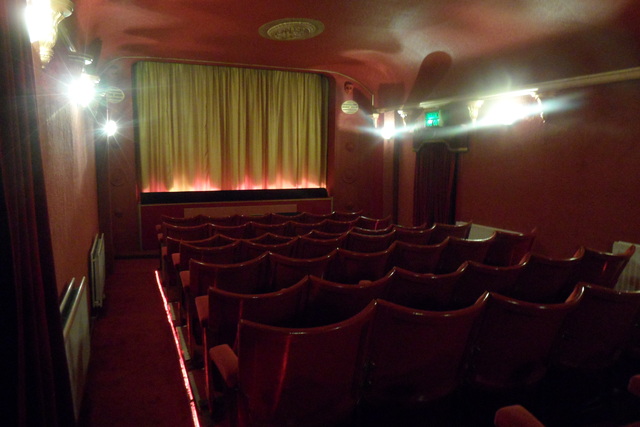
But few may know the origins of their name, which stems from a venue featured in the new segment of the blog. Welcome to Lesser Spotted Ulcer! Finally, the point of the post! Where every now and again, when I take the notion to remember, we visit one of Norn Iron’s hidden gems. No, really. tudor private cinema in comber county down northern ireland the tudor was built by brothers noel and roy spence in the garden of his house on what used to be a chicken shed First up, Tudor Cinema in Comber. A cute mispronunciation by a local boy inspired the moniker of his brilliant band. It’s privately owned by the lively Noel Spence, owner of 1000s of titles, which he will cheerfully allow you to scan through to book film and screen for a modest donation (no fees as such, or children allowed). Including E.T. and Misery. Donnie Darko, also. And The Blair Witch Project. Or any other film with a critical basement scene. He’ll even put up a personalised welcome message with the classic letters above the entrance. And if you’re lucky, he might give you a free copy of some native yarns and poetry in between performing his roving ice-lolly dolly duties. It takes a decent local map and frequent passenger-window-winding-down for directions to refine this map further, but it’s worth the recline into a red velvet seat when you do.

To Noel, my inaugural rosette. Go Noel (canned applause).

tudor interior

Tudor Cinema. (audience not pictured)

And that concludes this week’s edition. Tune in next time when we’ll be visiting the Stiff Little Fish Fingers factory.