Essential advice for the next generation from characters played by John Cusack

In random order of importance

“Liking both Marvin Gaye and Art Garfunkel is like supporting both the Israelis and the Palestinians.”

“People worry about kids playing with guns, and teenagers watching violent videos; we are scared that some sort of culture of violence will take them over. Nobody worries about kids listening to thousands–literally thousands–of songs about broken hearts and rejection and pain and misery and loss. The unhappiest people I know, romantically speaking, are the ones who like pop music the most; and I don’t know whether pop music has caused this unhappiness, but I do know that they’ve been listening to the sad songs longer than they’ve been living the unhappy lives.”

“Now, the making of a good compilation tape is a very subtle art. Many do’s and don’ts. First of all, you ‘re using someone else’s poetry to express how you feel. This is a delicate thing.”

“The making of a great compilation tape, like breaking up, is hard to do. It takes ages longer than it might seem. You gotta kick it off with a killer to grab attention. Then you gotta take it up a notch. But you don’t want to blow your wad. So then you gotta cool it off a notch. There are a lot of rules.”

“Jesus. I’m glad I know nothing about psychotherapy, about Jung and Freud and that lot. If I did, I’d probably be extremely frightened by now: the woman who wants to have sex in the place where she used to go for walks with her dead dad is probably very dangerous indeed.”

“If you start out depressed, everything’s kind of a pleasant surprise”

“Books, records, films – these things matter”

“I don’t want to sell anything, buy anything, or process anything as a career. I don’t want to sell anything bought or processed, or buy anything sold or processed, or process anything sold, bought, or processed, or repair anything sold, bought, or processed. You know, as a career, I don’t want to do that.”

[On choosing a career] “How many of them really know what they want, though? I mean, a lot of them think they have to know, right? But inside they don’t really know, so… I don’t know, but I know that I don’t know.”

[On a similar vein] “Nobody’s looking for a puppeteer in today’s wintry economic climate.”

“There is truth, and there are lies, and art always tells the truth. Even when it’s lying.”

“But the elderly have so much to offer, sir. they’re our link with history.”

“Consider outer space. You know, from the time of the first NASA mission, it was clear that outer space has a clear effect on the human psyche. Why, during the first Gemini mission, thought was actually given to sending up a man and a woman… together. A cosmic ‘Adam and Eve,’ if you will. Bound together by fate, situated on the most powerful rocket yet known to man. It’s giant thrusters blasting them into the dark void, as they hurtle towards their final destination: the gushing wellspring of life itself.”

“What the hell’s wrong with being stupid once in awhile? Does everything you do always have to be sensible? Haven’t you ever thrown water balloons off a roof? When you were a little kid didn’t you ever sprinkle Ivory flakes on the living room floor ’cause you wanted to make it snow in July? Didn’t you ever get really shitfaced and maybe make a complete fool of yourself and still have an excellent time?”

“The degree of civilization in a society can be judged by observing its prisoners.”  Dostoyevsky said that… after doin’ a little time. ”

“One little change has a ripple effect and it effects everything else. Like a butterfly floats its wings and Tokyo explodes or there’s a tsunami, in like, you know, somewhere.”
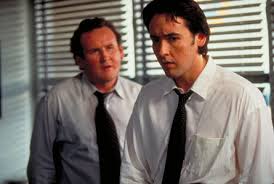
john cusack

Vince wonders if this is a good time to drop in that Dostoyevsky quote. But he’s not sure how to pronounce Dostoyevsky. Neither am I.
In the dark

The screen cuts to Richard Linklater’s editing suite where we catch a glimpse of the director fast forwarding and re-winding through a reel of footage from Boyhood.  He is giving his companion a glimpse into his then current project as it rounds the corner into its tenth year of filming.  The concept of striving to capture childhood is alluded to; as are the difficulties he had settling on one aspect of it on which to hone his efforts that consequently led to an unorthodox move for American cinema. He speaks of his relief that 35mm film is still around to see the project through to completion.  With the advent of digital film, he feared it would become extinct, presumably irrelevant, but clung on to the risky possibility of maintaining a consistent aesthetic throughout nonetheless.

His companion is fellow boundary-pushing outsider James Benning, and this is as technical as their discussions get. I’m in the audience for Double Play, a documentary following the reunion of the pair as they shoot some hoops in Linklater’s back yard, and the breeze as their conversation fast forwards and rewinds through their memories of falling into filmmaking and their respective pursuits and motivations that keep them at it. Both men are consumed by the idea of memory, and each orbits the shifting tides of time in unique, though surprisingly overlapping, ways. Quite literally in Benning’s case as we see him plant his camera along a lakeside for one of his many landscape based offerings on time’s passage in 13 Lakes.

I can’t claim to penetrate the precise meaning of their every exchange, but I could sit and listen to these two men all day. The gently spoken septuagenarian kitted out in denim from the ankles up reminding his younger peer that all of life is memory since the present has no definite dimensions to rely on; his middle-aged protégé of sorts extolling the virtues of cinema as the one reliable universe for all misfits unable to find their footing in the world; one that helps them to make sense of it. It’s how he himself stumbled into it – the mandatory viewings of four films in a row for the fugitive from his own surroundings. Stuck in a void. We’ve all been there. Haven’t we? It’s why I keep returning.

There is little sense to console the audience as we exit Melbourne later in the evening. Set in a single-location real-time Tehran on the day a couple prepares to emigrate to the film’s antipodean location, the consequences of an unscheduled favour holds the central characters and the audience hostage to an unbearable discovery. This self-assured, consummately acted Iranian drama, torments the couple with the senseless occurrences of life and the never-knowing what was within their control. The elusive dimensions of the present cheats them out of all certainty, and the future they’d banked on. Highly recommended.

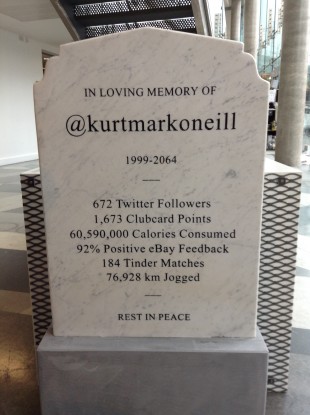
It’s hard not to think of wise man Benning as I scan a few pages of Nicholas Felton’s Annual Reports the following morning.  Felton has been recording and compiling the minutiae of his daily life since 2005. A wet dream for any graphophile, they concisely break down his life in journeys, books read, films watched, times Bono cursed, photos taken, shits had, coffee outings gone on, and so on and so forth into the format global companies fawn over consultants to produce. The Felton Reports form part of the current Lifelogging exhibition at Dublin Science Gallery that includes some witty considerations on the dominance of social media in our lives, and its rise as a credible measure of our worth.

tombstone

In eloving memory

Is the measured life a better life? Perhaps. But for all the breadth of biographical info, the emergence of patterns, the dimensions of activities and proclivities, it is one’s memory of those experiences that gives them their true meaning and measurement.

Image: Dublin Science Gallery.

For more info on the Lifelogging exhibition see here.

Seven reasons to see Boyhood

boyhood

1. For its story on childhood

2. For its story on motherhood

3. For its story on fatherhood

4. The delicate stacking of these stories into the film’s central arc on aging.

5. The bang-on casting of the wonderful Patricia Arquette, Ellar Coltrane, Ethan Hawke, and Lorilei Linklater

6. The timely reminder that everyone is winging it, irrespective of age, and the best signposts on the road-map to doing-your-best-parenting comes from your own child, not a parenting book.

7. The comforting hallmarks of Richard Linklater: posing more questions than answers; the pointlessness in searching for these answers, propped up by the human purpose to attempt it anyway; and the importance  of seeking out the right music in the quest to give the questions some meaning.

Review: The Theory of Everything

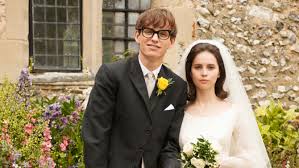
theory of everything

Dublin folklore has it that on hearing Stephen Hawking was in the same local restaurant, another diner couldn’t resist approaching the eminent physicist to gushingly tell him how great he was… in The Simpsons. Urban myth? One likes to hope not, because if his mischievous wit revealed in this film is anything to go by, he would’ve had quite the chuckle at it.

Such is Hawking’s iconic status in popular culture, he even managed to graduate from the esteemed campus of Springfield. A career high along with a few other achievements, notably the odd theoretical breakthrough over the years initially showcased in his 1988 seminal work A Brief History of Time.

Films-goers fearing this one is for science boffins can heave a sigh of relief. There is, of course, the mandatory blackboard littered with enough impenetrable equations to trigger a nasty flashback among even the least maths averse of viewer, and the occasional chin-stroke exchanged between student and mentor (an unlikely David Thewlis); but theoretical physics is peripheral to the film’s main task of deftly unravelling the chemical reactions between two people over the course of a lengthy relationship, which both expected to be short-lived.

The film opens with the young erudite Hawking (a flawless Eddie Redmayne) strutting through the corridors of Cambridge dithering over what topic to chose for his PhD thesis, and marshaling his propensity for probability into the most prosaic of activities (the durability of an affair between characters in a film he watches, for example) in that self-deprecating way that only very smart people can. A collision with a student of Spanish and French poetry (“medieval poetry of the Iberian Peninsula” to be exact), Jane Wilde (Felicity Jones), leaves them both starry-eyed. The two soon strike up a romance only for the heady rush of early love to be cruelly interrupted by his diagnosis of Motor Neuron Disease. Undeterred, Wilde declares her devotion, and the couple grab the remaining time available to them to dive headlong into marriage and family life.

Based on an adaptation of Jane Hawking’s book Travelling to Infinity: My Life with Stephen Hawking, the film chronicles their relationship over the subsequent thirty years. That it received the blessing from the entire Hawking family lends it an authenticity that allows the viewer to absorb the tenderness and tensions between them with the knowledge that they’re not being manipulated by any over-cooked schmaltz that the makers commendably manage to avoid.

Redmayne impresses with his uncanny portrayal of Hawking’s transition from youthful clumsiness through to middle-age with voice-assisted communication; while Jones captures Jane’s early unwavering devotion, and the ensuing complexities and challenges that inevitably arise from inhabiting a long-term caring role, with conviction.

An affecting, humorous, portrait of a couple that doubles up as Oscar bait with integrity. Also includes a crash-course in black hole singularity (whatever that is) using the aid of peas and spuds for the here-comes-the-science part. And toffs saunter about in gowns in between squashing into ye olde English pubs. Something for everyone then.

4/5

“Posh cunts telling thick cunts to kill poor cunts”

Almost the perfect definition of British ‘peacekeeping’ tactics in Northern Ireland. Or much of state sponsored terrorism anywhere in the globe. Sadly, not a line I can claim as my own, though I suspect it will be one I’ll reach for regularly from here in. It made its way straight into my top five favourite film quotes this weekend after flipping forward from the calm but bitter gob of Richard Dormer’s do-gooder character in ’71.

71

I didn’t expect to get caught up in a stampede towards a film related to The Troubles; they’re not exactly renowned for their entertainment value. Nor did I anticipate being one half of the entire audience in the opening week of the film’s release. Normally this would be something to rejoice about, but I’m hoping the poster of a tooled up teenager in a British Army uniform patrolling a Belfast street, won’t kill off viewer interest.

Apart from some brief and crude context setting, this could be set in any conflict zone. The finer political details are merely a backdrop to this thrilling assault course that criss-crosses enemy lines over a single night in Belfast. It follows the nail-biting scrapes encountered by a new wet-behind-the-rifle recruit (Jack O’Connell) after he is left behind by his squad as they leg it from a hairy battle with the locals.

Few words are divvied out to O’Connell, so it’s testament to his presence that he pulls off the rare mix of brawn, vulnerability, and bewilderment on which the guts of the film hangs so compellingly.

Good Vibrations wore The Troubles lightly a few years back (again with the underrated Dormer at its centre). Could we finally be rounding the corner into the possibility of a broader palette of film action in which the politics are relegated to background status? Ulster says Yes. Please.

One of the best films of the year.

Winning losers

Overhearing a discussion on best film quotes on the radio earlier, I got to thinking about a few of my own favourites. “No fucking Merlot”. Now, there’s one I managed to misquote and rapidly rip the arse out of by converting it into an annoying euphemism for a grave warning against any activity requiring a grave warning. Weddings. Work. Worshipping. And other activities possibly beginning with W. Weeding. Waxing. Weight-watchers etc.

That thought led to another that had me mentally flicking through my favourite losers on film:

Paul Giamatti in Sideways

Our man with the original irrational objection to a certain grape whose name we’ll not risk repeating. If ever a gong were to be given for best hang-dog face, Giamatti would be hangover head and shoulders above the competition. He was already a serious contender with his turn in American Splendour. But it was as Miles, the down – and almost out – aspiring writer, he was crowned King of the anti-heroes. Poor Miles. His pleading eyebrows at risk of being upstaged by his mournful hairline. Suffering the ignominy of another rejected manuscript. Devastated to learn his ex-wife is about to get re-married, he seeks sanctuary in glass after bottle after crate of the only faithful partner in life – wine.

His unbearable sadness is stemmed in the closing scene by an answer machine message that leaves a spaghetti junction of tears down my face every time I watch it. Everything is going to be OK, Miles. I hope.

Ryan Gosling in Blue Valentine

Most gong-giving ceremonies are a load of cack, but the omission of Ryan Gosling from the short-list for his performance in this was a serious miscarriage of justice. He had already nailed the mixed-up modern day village idiot tenderly in Lars and The Real Girl. At times, he was hellish to watch here. The forwards/backwards chronicling of his disintegrating relationship with Cindy (Michelle Williams) meant he essentially had to play two different people throughout the film. We go from Dean, the charming ukulele serenading seducer to Dean, the receding hair-lined fugitive from drive and ambition, with a fondness for an evening beer over breakfast. Dean externalises his feelings, therefore doing double the work required of the more reticent Cindy. Bagging a pair of puffy black eyes from a brutal beating was not enough to keep her.

Richard E. Grant in Withnail & I

No further words of appreciation can be awarded to this tweed-coat wearing icon that haven’t already been uttered in a hectic scramble to get in first with the quotes. So I’ll leave it there. OK, just let me have the one – “Monty! You terrible cunt”

David Thewlis in Naked

It wouldn’t be a list of losers without a Mike Leigh creation featuring in the mix. So many to choose from. Brenda Blethyn in Secrets and Lies. Timothy Spall in All Or Nothing. But there’s really no-one to rival David Thewlis’s Johnny in terms of eloquent speechifying, overbearing nihilism, reckless provocation, and self-destruction. Johnny erupts on to the screen to do his darndest to push everyone away including the audience. He would succeed, if he wasn’t such compelling viewing. Like the mumblings of that old drunk who rummaged through the bin next to the chipper where I once worked, his diatribes are shot through with moments of lucid brilliance. Like Johnny, it wasn’t hard to guess a thousand let-downs in his life shoved him out of safety onto a city street with a bench that became his bed.

Thewlis went on to appear in Harry Potter. How the damaged have fallen.

Bill Murray in Lost in Translation

“Ladies and Gentlemen, Mr. Bob Harris….”

Feel free to add your favourites…

Just the one of us

In typically oxygen deprived fashion, I kamikaze into the box office, wheezing the name of the film in the vain hope I’ve made it on time. Even allowing for trailers, mobile phone warnings, reminders of obscenely priced snacks in the foyer, orders to eat with your mouth shut and avoid loud breathing, opening credits, and opening lines… it’s too late. The film started twenty minutes ago. Another waste of a graceless gallop through a car-park. I settle on my second choice showing an hour later and slope off to the adjoining pub to cool down and grab a bite to eat.

It’s not everyday you get your bill handed in a relic from the ’80s. No, not in a leg-warmer or on a butter voucher, but inventively slid into an empty cassette cover. I turn it over to find a young Martin McGuinness bow-tied Art Garfunkel gazing back at me. I tend to have that effect on album covers. The track list includes the title track and a bunch of unrecognisable songs. Paul Simon receives a backing vocal credit. A probe later on Wiki fills in some blanks. Released in 1981, it was the second of Garfunkel’s solo albums that failed to fly under the Top 40 radar. He dedicated it to actor/photographer, Laurie Bird, who died tragically by suicide in the home she shared with the singer at the tender age of 25. He became so reclusive following her death, he didn’t release another album until 1988.

We’ll have to take his word for it, and dismiss any suspicions that his hiatus had anything to do with the commercial flop or the bow tie, or indeed the numerous credits to cheese recorded on the album. Wikipedia was unable to furnish me with details on how a copy ended up in a Dublin pub. No-one will come forward to admit they own it. Sometimes I feel the same about my Paul Young LPs.

art

Garfunkel following his first split from Gerry Adams

A month after the album’s release, Garfunkel had reunited with Paul Simon for their famous benefit gig, The Concert in Central Park. The reunion was short-lived. Tensions between the duo continued to re-surface with subsequent live tours, and shelved attempts at studio recordings, punctuated by periods of estrangement. This mattered not a jot in terms of the enduring appeal of their albums.

Next year, Paul Simon will return to Dublin for a live show with… Sting. This tells us something about just how insufferable Garfunkel must’ve been. The show will kick off a series of gigs featuring unlikely musical  bedfellows. Other acts confirmed include Noel Gallagher with Mick Hucknall, Paul McCartney with Ronan Keating, followed by Sinead O’Connor with Nathan Carter. I just made that last sentence up. But the Simon-Sting show is confirmed, and will likely cost punters the equivalent of a vital internal organ for the pleasure. If their idea of pleasure is having an enema. I say that as an enthusiastic Paul Simon fan.

I slip back out, handing the cassette case to the waiter with a Euro note replacing the bill. Now That’s What I Call Service Vol 1 (sorry).

It’s hard to beat a late afternoon pint alone in a quiet pub; but it’s harder to describe the superior therapeutic benefits of a solo run to the cinema. It all happens in the dark against the screen light. Escapism meets universal themes that lift lids on personal matters that occasionally answer back your own internal dialogue.

Looking at the hip-flask pouring, miserable, over-weight, underwhelmed character played by Philip Seymour Hoffman, it is tempting to intuit overlaps in the psychological condition of the actor and the man he portrayed in his final performance before his tragic death earlier this year. As ever, he is the most intriguing presence on the screen. A one-off. A Most Wanted Man – an eerily appropriate title to an otherwise mediocre tale of espionage.

Coincidentally, the film I really wanted to see was ‘Obvious Child’. Next time.

The waltz continues

Amid daily news “packages” on the recurrent onslaught of murder in Gaza, sits the regulation feature on the rising role of social media in modern conflict. The civilian on the street doubling as handheld eye-witness circumnavigating sponsored camera crews and editorial policies to give the world in-our-face, access-all-areas updates in real time.

Social media’s attack on sophisticated propaganda and news management is undoubtedly a phenomenon that tears up the rule book on war reporting. Even so, the experiences of those recruited for combat remain off-limits. The access-all-emotional-areas of those young men conscripted into forces defending their lands be it in fatigues or keffiyehs.

Most of us are veterans of watching war reports and war films, but few war veterans are reporters or filmmakers. Ari Folman is one. Conscripted into the IDF, he fought as a 19 year-old soldier in the Israeli invasion of Lebanon in 1982. His 2008 documentary film Waltz With Bashir recounts the experiences his young wet-behind-the-rifle squad shared on the front-line.

walzt

What sets the film apart from other talking head documentaries is the animation format through which these are captured. It enables the film to accommodate the unsettling hallucinatory and fractured quality of the memories of men from a time when they had barely crossed the threshold of adulthood. The wooziness, and the tricks memories play, toys with the viewer’s engagement immersing it in blurred interpretations. We’re kept guessing throughout. That the film was applauded by both supporters of the Israeli government and Palestinian liberation leaves sufficient ambiguity for soothing moral detachment as certainty.

But it’s not all detached reconstruction. The sudden shift to actual film footage in the closing minutes jolts the audience into the final inescapable confrontation between the soldier and his hitherto ambiguous flashbacks. Like the daily feeds down cables and phone cameras today, the footage screams for itself.

Striking the right note

Definition of feeling conflicted: itching to see a film that features an actor in the lead who gives you chronic reflux.

Begin Again is written and directed by John Carney of Bachelors Walk, On the Edge, and Once semi-fame (his work in my order of merit). Mark Ruffalo turns up looking the worse for wear from the set of The Kids Are All Right as the ramshackled down-on-his-luck A&R scout. Other cast members include iconic New York, Catherine Keener, and Stevie Wonder on the soundtrack. What’s not to love?

Keira Knightley. An acting ironing board or a poor woman’s Natalie Portman? Credit to Carney for making me care less with the naturalistic performances he woos from his cast, and all round charm of this unabashed love letter to music. Even James Corden is mildly bearable.

But the best lines are reserved for the perenially watchable Ruffalo. “Even the most benign scene is invested with meaning”. He is sitting on night-time steps of Downtown Manhattan listening to Stevie Wonder absorbing the urban streetcape details unfolding all around. Flickering neons, walkers-by making walk-on cameos unbeknownst to them, big yellow taxis floating past.

Any casual wearer of ear-phones will relate. Your heart might overheat from the overwhelming resonance of someone describing something in a THAT’S IT! kinda way. Mine did. Put me on a train with a Blue Nile album and I’m directing my own epic scene by the time it pulls away from the station. If the camera were to pan away it would reveal the Enterprise rolling through the blandlands of Louth. But it’s all “chimney tops, the trumpets, golden lights, the loving prayers” through an aural lens.

Carney is set to add a third installment to his loose musical trilogy. Once propelled him Glen Hansard onto the international scene but the director already had form in marrying the right tune with the emotion of a cinematic moment.

Smashing Pumpkins’ 1979 opens the overlooked ‘On the Edge’, introducing us to a troubled Cillian Murphy hovering over his Father’s coffin in a church before legging it on his bike to negotiate rushhour on South Circular Road; The Jam’s ‘Start’  zips alongside him through the neon lit streets in a stolen jamjar, before things slow down with The Frames’s Seven Day Mile when hope dances with possibility at a house party.

Still in the running for gong for best song in a closing scene is the finale of the first season of Bachelors Walk. The three flatmates are all out of luck. They gather on the sofa and sink into a silent sorrow to the best song on lost boyhood ever.

Next time on Striking the right note (part II) – best uses of music in non-John Carney films. And Morag will be here with embarrasing notes from my teenage crushes.

They’re so disarming, darling

One of the countless comedy gold moments in Tom Berninger’s ‘Mistaken For Strangers’  arises during the director’s interview with Bryce Dessner. The lead guitarist, and one fifth of indie music messiahs, The National, bristles at the line of questioning.

“I thought you wanted to talk about me but it seems you just want to talk about Matt. That tends to happen a lot”.

Matt is lead singer with the band. As Tom’s older brother, he charitably invites him along on the world tour bus for a year to preside over essential duties like fetching towels and assembling the daily wish-list of goodies on the rider. All of which he undertakes with spectacular incompetency.

The feckless and disarmingly charming Tom has other ideas. Including having a good time in stereotypically rawk star fashion while honing his amateur filmmaking skills. Assembled from 200 hours of handheld camera footage,  Tom’s approach is less fly-on-the-wall than irritating mosquito-round-the-ear the band and crew just about endure until he’s batted off the bus.

Like Dessner, this viewer was expecting a reverent behind-the-scenes portrait of a band floating on the milky way of hard fought success. Those moments arrive, often hilariously, but quickly become the trampoline on which the Berningers bounce reflections on their lives and dreams: as individuals in pursuit of creative purpose; as men who have been in combat with the demons of self-doubt and failure; as one perpetually sizing up the other. But mainly as brothers. Their overlaps and differences are threaded together through the eyes of each, and others. As is the tenderness and good-humoured affection that has them reclining in deckchairs shooting the breeze with beer, counting their winnings from luck,  and from making the film we’re watching them in. Possibly the best leg-up from a big brother to a younger towards that elusive sense of achievement.

A gem. Not just for music-lovers and those who love an exquisite use of a New Order song in film. Currently showing at The Light House.